Silver has fascinated people for thousands of years. Its bright appearance, workability, and relative rarity have made it an important material for jewelry, currency, ceremonial objects, and decorative arts.
From ancient Egyptian ornaments to medieval European silverware and contemporary jewelry collections, silver has played a significant role in human history.
Today, one of the most widely recognized forms of silver used in jewelry is 925 sterling silver, an alloy containing 92.5% pure silver.
But sterling silver did not appear at the beginning of silverworking history. Its development was part of a much longer process involving trade, metallurgy, craftsmanship, and standards for precious metals.
In this article, we explore the history of silver, the origins of sterling silver, and how this versatile material became an essential part of modern jewelry manufacturing.
Silver in Ancient Civilizations
Silver was used long before the development of the modern sterling silver standard.
Archaeological evidence shows that ancient civilizations worked with silver for jewelry, ornaments, and other valuable objects thousands of years ago.
Its naturally bright appearance made it desirable, while its ability to be shaped and worked into decorative forms encouraged the development of early silversmithing techniques.
Ancient Mesopotamia
Silver played an important role in the economies and cultures of ancient Mesopotamia.
It was used in jewelry, decorative objects, and systems of trade and exchange.
Silver was also valued as a material that could be weighed and used to express economic value.
Early metalworkers developed techniques for shaping, joining, and decorating precious metals, laying foundations for later jewelry-making traditions.
Ancient Egypt
Silver was used in ancient Egyptian jewelry and ceremonial objects, although gold is often more closely associated with Egyptian treasures.
During certain periods, silver was less readily available in Egypt than gold and could be especially valuable.
Egyptian artisans created ornaments using precious metals, gemstones, and decorative techniques that demonstrated considerable technical skill.
Silver appeared in personal adornment, including jewelry associated with wealth and status.
However, these ancient silver objects should not automatically be described as sterling silver. Their alloy compositions varied, and the modern 925 standard had not yet been established.
Ancient Greece and Rome
Greek and Roman societies used silver extensively.
It appeared in coins, jewelry, tableware, religious objects, and decorative metalwork.
Roman silversmiths developed sophisticated methods of casting, hammering, engraving, and joining metal components.
Silver jewelry included rings, bracelets, necklaces, and other personal accessories.
Although the Romans used silver alloys, it would be historically inaccurate to suggest that they established the modern sterling silver standard.
The history of silverworking and the history of sterling silver are related, but they are not identical.
The Origins of Sterling Silver
The development of sterling silver is closely associated with medieval Europe, particularly England.
As trade expanded, merchants and authorities needed ways to establish confidence in the quality of silver used for coins and manufactured goods.
Different regions used various silver alloys and purity requirements.
Over time, the sterling standard became associated with a silver content of 92.5%.
This composition offered a useful balance between precious-metal content and practical working properties.
Where Does the Word “Sterling” Come From?
The exact origin of the word sterling has been debated by historians and linguists.
Several historical explanations have been proposed, including connections with medieval coinage and terminology used in European trade.
Because the etymology is not completely settled, it is better to avoid presenting one popular explanation as an established fact.
What is clear is that the term became strongly associated with English silver currency and, eventually, a recognized standard of silver purity.
Why Is Sterling Silver 92.5% Pure?
Pure silver, also known as fine silver, is relatively soft.
Although it can be used in jewelry, its softness may limit its suitability for certain designs and components exposed to regular wear.
By combining silver with other metals, manufacturers can improve properties such as hardness and strength.
Modern sterling silver contains:
- 92.5% silver
- 7.5% other metals, commonly copper
The addition of copper helps make sterling silver more practical for many types of jewelry.
This composition is commonly identified by the number 925.
The 925 designation refers to 925 parts of silver per 1,000 parts of the alloy.
For example, a piece made from 10 grams of standard sterling silver contains 9.25 grams of silver and 0.75 grams of other alloying metals.
The alloy composition is only one factor in jewelry durability. Design, thickness, manufacturing quality, and intended use are also important.
Medieval England and the Development of Silver Standards
During the Middle Ages, silver became an important material for currency, trade, and valuable household objects.
As its commercial importance increased, authorities introduced systems intended to protect buyers and establish confidence in precious-metal quality.
England developed a long tradition of regulating and testing silver.
Historical records connect the sterling standard with medieval English monetary and metalworking practices.
The Importance of Hallmarking
Hallmarking developed as a way to identify precious-metal quality and, in some systems, provide information about testing authorities, makers, or dates.
England’s hallmarking history extends back to the medieval period, including important regulations introduced during the 14th century.
These systems evolved over time and contributed to the development of formal precious-metal testing and identification.
Today, hallmarking requirements vary between countries.
A piece stamped 925 may indicate sterling silver, but the stamp alone does not guarantee authenticity.
For commercial transactions, material testing, reliable supplier documentation, and compliance with applicable standards may provide additional assurance.
Sterling Silver During the Renaissance
The Renaissance brought important developments in European art, design, and craftsmanship.
Silversmiths produced elaborate decorative objects, ceremonial pieces, tableware, and jewelry.
Craftspeople experimented with forms inspired by architecture, nature, classical art, and religious traditions.
Techniques such as engraving, chasing, repoussé, and casting allowed artisans to create increasingly detailed metalwork.
Silver objects also became expressions of wealth, artistic taste, and social position.
During this period, skilled silversmiths often worked within established craft traditions and workshop systems.
Their expertise combined technical metalworking with artistic design.
Many of the underlying techniques remain relevant to jewelry manufacturing today.
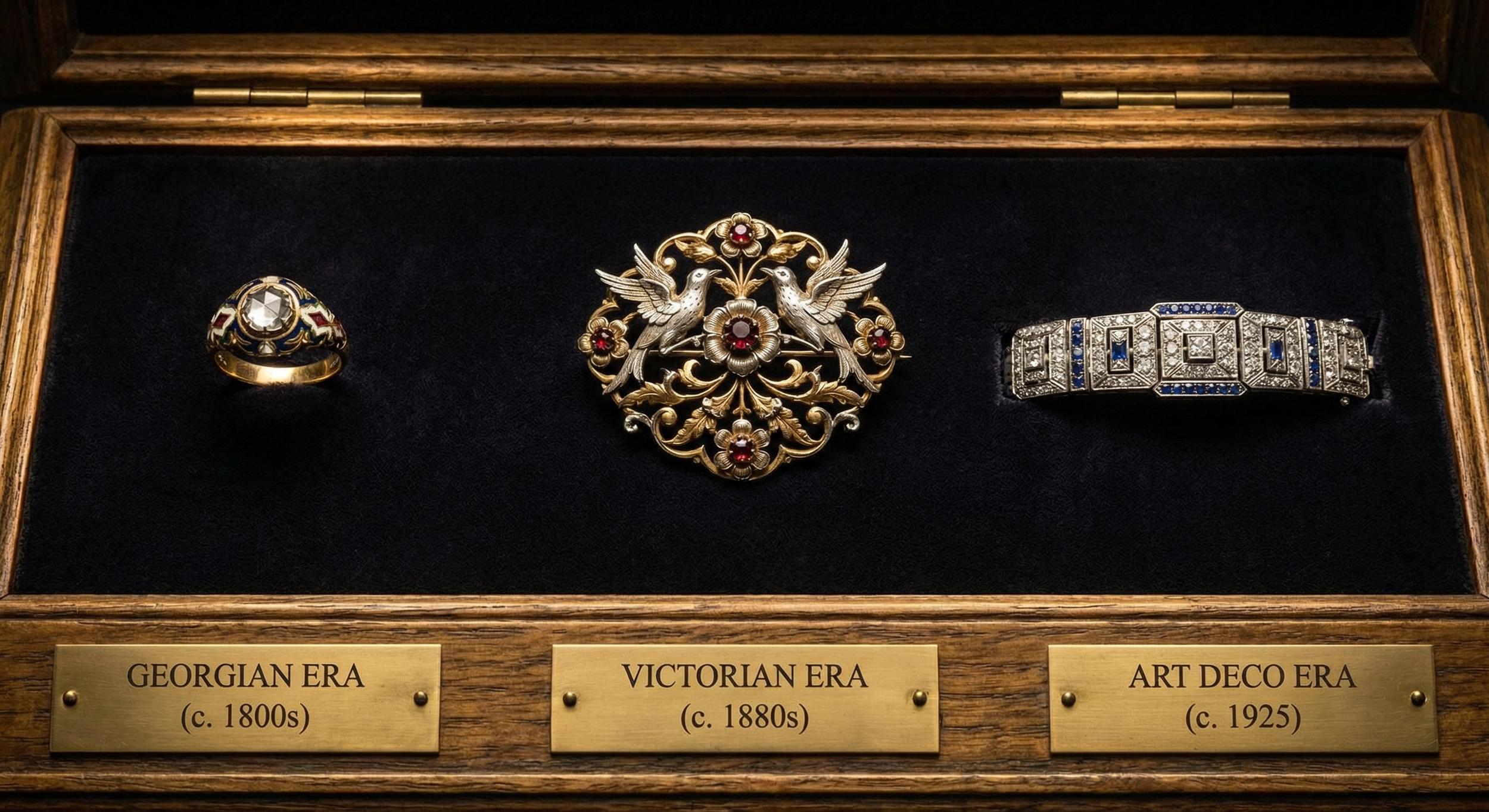
The Georgian and Victorian Eras: Silver Jewelry Becomes More Diverse
European jewelry styles continued to evolve during the 18th and 19th centuries.
The Georgian period saw jewelry incorporating elaborate metalwork, gemstones, and designs influenced by contemporary fashion.
During the Victorian era, jewelry became closely associated with personal sentiment and symbolism.
Lockets, brooches, bracelets, and engraved pieces were popular forms of adornment.
Silver was used in a variety of jewelry constructions, sometimes alongside gold or other materials.
Sentimental Jewelry
Jewelry could commemorate relationships, important events, or loved ones.
Lockets containing photographs or other personal keepsakes became particularly meaningful.
Engraved jewelry and symbolic motifs also allowed wearers to express personal connections.
These traditions continue to influence contemporary personalized jewelry.
Advances in Manufacturing
Industrial development gradually introduced new tools, production methods, and manufacturing capabilities.
Processes such as stamping, mechanical forming, and improved casting supported greater production efficiency.
However, traditional handwork remained important for intricate designs, specialized construction, and finishing.
This relationship between machinery and skilled craftsmanship continues in modern jewelry manufacturing.
Sterling Silver in the 20th Century
The 20th century brought significant changes to jewelry design.
Artistic movements, fashion trends, and manufacturing developments encouraged designers to experiment with new forms and materials.
Sterling silver became an important material for both traditional and contemporary jewelry.
Art Nouveau
Art Nouveau jewelry drew inspiration from flowing lines, flowers, insects, and other natural forms.
Silver and other metals could be used to create expressive, organic designs.
Art Deco
Art Deco introduced geometric shapes, symmetry, and bold decorative arrangements.
Silver jewelry could incorporate clean lines, contrasting surfaces, and gemstone accents.
Modernist Jewelry
Modernist designers explored abstract forms, simplified construction, and unconventional proportions.
Sterling silver was particularly useful because it could be shaped into sculptural and expressive designs.
Contemporary Fashion Jewelry
As manufacturing technology developed, sterling silver became available in an increasingly broad range of products.
Simple silver chains, rings, earrings, bracelets, and pendants became popular across different price ranges and fashion styles.
The metal’s versatility allowed it to support both everyday jewelry and more elaborate designer collections.
How Sterling Silver Jewelry Is Manufactured Today
Modern sterling silver jewelry manufacturing combines techniques developed over centuries with contemporary technology.
The appropriate production method depends on the design, required quantity, dimensions, and finishing specifications.
Hand Fabrication
Hand fabrication involves constructing jewelry from silver sheet, wire, tubing, and other metal components.
Artisans cut, bend, shape, solder, and assemble these components.
This approach is useful for certain custom designs, decorative techniques, and specialized constructions.
Lost-Wax Casting
Lost-wax casting is widely used to manufacture jewelry with complex shapes.
A model is used to create a mold cavity, into which molten silver alloy is cast.
After casting, the components undergo additional work such as filing, assembly, stone setting, and polishing.
Casting can support repeatable production while still requiring skilled finishing.
CAD and 3D Printing
Computer-aided design allows jewelry to be developed as precise three-dimensional models.
Designers and manufacturers can review dimensions and proportions before creating physical samples.
3D printing may be used to produce models or patterns suitable for subsequent manufacturing.
These technologies are particularly useful when collaborating with international jewelry brands.
Stone Setting and Finishing
Gemstones, pearls, and other decorative materials can be incorporated into sterling silver jewelry.
The setting method must suit the stone and the design.
Finishing options may include high polish, satin, brushed, textured, or oxidized surfaces.
Some jewelry also receives plating, such as gold or rhodium, according to the required appearance and specifications.
Although technology has improved many processes, skilled workers remain essential for evaluating construction, assembling components, and achieving consistent finishing.
Sterling Silver vs. Fine Silver vs. Silver-Plated Jewelry
These terms are sometimes confused, but they describe different materials.
| Material | Typical composition | Characteristics |
|---|---|---|
| Fine silver | 99.9% silver | High purity, relatively soft |
| Sterling silver | 92.5% silver | Common jewelry alloy with improved strength |
| Silver-plated jewelry | Base metal with a silver coating | Silver surface over another material |
Fine silver can be suitable for selected jewelry techniques and designs, but sterling silver is generally more practical for many everyday jewelry applications.
Silver-plated jewelry may resemble sterling silver when new, but the underlying metal is different.
Over time, a plated surface may wear depending on the coating thickness, use, and environmental exposure.
For buyers and jewelry brands, clear material descriptions are important.
The appearance of a product alone does not establish its metal composition.
Why Sterling Silver Remains Popular in Modern Jewelry
Sterling silver continues to appeal to designers and consumers for several reasons.
Versatile Design Possibilities
Sterling silver can be used for minimalist jewelry, bold statement pieces, traditional ornaments, and contemporary sculptural designs.
Its properties support various manufacturing methods and finishing techniques.
Compatibility with Gemstones
Sterling silver can be combined with many types of gemstones and decorative materials.
The setting must be designed according to the characteristics of the stone and the intended use.
A Precious-Metal Alternative to Gold
Sterling silver generally has a lower material cost than solid gold, although finished jewelry prices depend on many factors beyond metal content.
Design complexity, labor, gemstones, finishing, and brand positioning all influence the final price.
Different Surface Finishes
Silver can be polished to a bright shine or given textured, brushed, satin, or intentionally oxidized finishes.
These variations allow designers to create different appearances using the same base metal.
Long-Term Wearability
Well-constructed sterling silver jewelry can remain wearable for many years with appropriate care and maintenance.
However, durability depends on construction and usage, not simply the silver content.
Does Sterling Silver Tarnish?
Yes. Sterling silver can develop tarnish over time.
Tarnish occurs when silver reacts with sulfur-containing substances in the environment.
It may appear as yellow, brown, gray, or black discoloration.
Humidity, cosmetics, perspiration, and certain chemicals can contribute to changes in appearance.
Tarnishing does not automatically mean that the jewelry is poor quality or counterfeit.
For suitable plain sterling silver pieces, gentle cleaning and appropriate silver polishing products can help maintain the surface.
Special care is necessary for jewelry with oxidized finishes, gold plating, pearls, opals, or other delicate materials.
Read our guide: How to Clean and Care for Sterling Silver Jewelry at Home.
Recycled Sterling Silver and Responsible Manufacturing
The growing interest in responsible manufacturing has encouraged jewelry businesses to consider recycled precious metals.
Silver can be recovered from suitable sources, refined, and reused.
When properly refined and alloyed, recycled silver can meet the same composition requirements as sterling silver made from newly mined material.
However, recycled content should not automatically be presented as proof that a finished jewelry product has no environmental impact.
Energy use, production waste, chemical handling, transportation, and other manufacturing factors also matter.
For jewelry brands, recycled-metal claims should be supported by appropriate supplier information or documentation.
Responsible manufacturing requires attention to both material sourcing and production practices.
The History of Sterling Silver Meets Balinese Craftsmanship
Although the sterling silver standard developed in Europe, silverworking traditions exist in many parts of the world.
Bali, Indonesia, is one of the locations recognized for its distinctive silver jewelry craftsmanship.
Traditional Balinese jewelry often features decorative techniques such as granulation, filigree, engraving, and oxidized finishing.
Communities in and around Celuk Village in Gianyar have developed strong associations with silver and gold jewelry production.
Over time, Bali’s jewelry industry expanded to serve both local customers and international markets.
Today, workshops in Bali produce a broad range of designs, from traditional ornamental jewelry to contemporary collections developed for overseas brands.
Traditional Techniques and Modern Production
Balinese silversmiths may use hand fabrication, casting, soldering, stone setting, and finishing techniques depending on the product.
Some workshops also use CAD, 3D printing, and modern production equipment.
These approaches are not mutually exclusive.
A piece of jewelry may begin with a digital model, be produced through casting, and then receive extensive hand finishing.
The combination of traditional knowledge and modern manufacturing methods is an important part of Bali’s contemporary jewelry industry.
For more information, explore our article Bali Silver Jewelry: A Timeless Craft.
Sterling Silver Jewelry Manufacturing at Puri Lautan Mutiara
At Puri Lautan Mutiara, we have been involved in jewelry manufacturing in Bali since 1998.
Our workshop is located in Singapadu, Gianyar, near the traditional jewelry-making area of Celuk.
We work with international jewelry designers, brands, retailers, and wholesalers on custom jewelry development and manufacturing.
Sterling silver 925 is one of our principal manufacturing materials.
Depending on the project, our processes may include CAD-assisted design development, wax modeling, lost-wax casting, hand fabrication, soldering, stone setting, and finishing.
We also work with brass, selected gold alloys, and other suitable jewelry materials.
As a small jewelry manufacturing business, we focus on practical communication, design feasibility, and consistent production according to agreed specifications.
For us, sterling silver is not only a material with a long history. It is also a versatile metal that continues to support new design possibilities.
Learn more about our Custom Jewelry Manufacturing Services.
Frequently Asked Questions About Sterling Silver
When was sterling silver invented?
Silver has been used for thousands of years, but the sterling silver standard developed much later, particularly through medieval European and English silver practices. It should not be confused with ancient silver alloys.
What does 925 mean on jewelry?
The number 925 indicates a silver content of 92.5%, equivalent to 925 parts per thousand.
Is sterling silver real silver?
Yes. Sterling silver is a genuine precious-metal alloy containing 92.5% silver.
Is sterling silver better than pure silver for jewelry?
Sterling silver is often more practical for everyday jewelry because alloying improves its strength and hardness. However, fine silver may be preferred for certain designs and techniques.
Can sterling silver last a lifetime?
Well-made sterling silver jewelry can remain usable for many years and may be passed between generations. Its longevity depends on construction, wear, maintenance, and any repairs required.
Why does sterling silver turn black?
Darkening is often caused by tarnish resulting from reactions with sulfur-containing substances. Some jewelry also features intentional oxidation as a decorative finish.
Is all Bali silver jewelry made from sterling silver?
No. Jewelry manufactured or sold in Bali may use sterling silver, fine silver, silver plating, brass, or other materials. Buyers should confirm the product specification.
Conclusion: A Precious Metal with a Lasting History
The history of sterling silver is part of a much larger story about the human use of precious metals.
Ancient civilizations valued silver for its beauty and practical uses.
Medieval European trade and metalworking practices contributed to the development of recognized silver standards.
Later generations of artisans expanded the possibilities of silver through new techniques, artistic movements, and manufacturing technology.
Today, sterling silver remains one of the most versatile materials in jewelry design.
Its continued popularity reflects a combination of precious-metal value, practical properties, craftsmanship, and creative possibilities.
From historical ornaments to modern jewelry collections manufactured in Bali, silver continues to connect traditional skills with contemporary design.
Planning to develop your own sterling silver jewelry collection?
Contact Puri Lautan Mutiara to discuss your designs, materials, sampling, and manufacturing requirements.
Puri Lautan Mutiara — Custom Jewelry Manufacturing in Bali Since 1998.
References and Further Reading
- The Goldsmiths’ Company Assay Office — British hallmarking and precious-metal testing.
- The British Museum — Historical silver objects, jewelry, and collections.
- Victoria and Albert Museum — Decorative arts, jewelry, and historical silverwork.
- The Metropolitan Museum of Art — Ancient and historical jewelry collections.