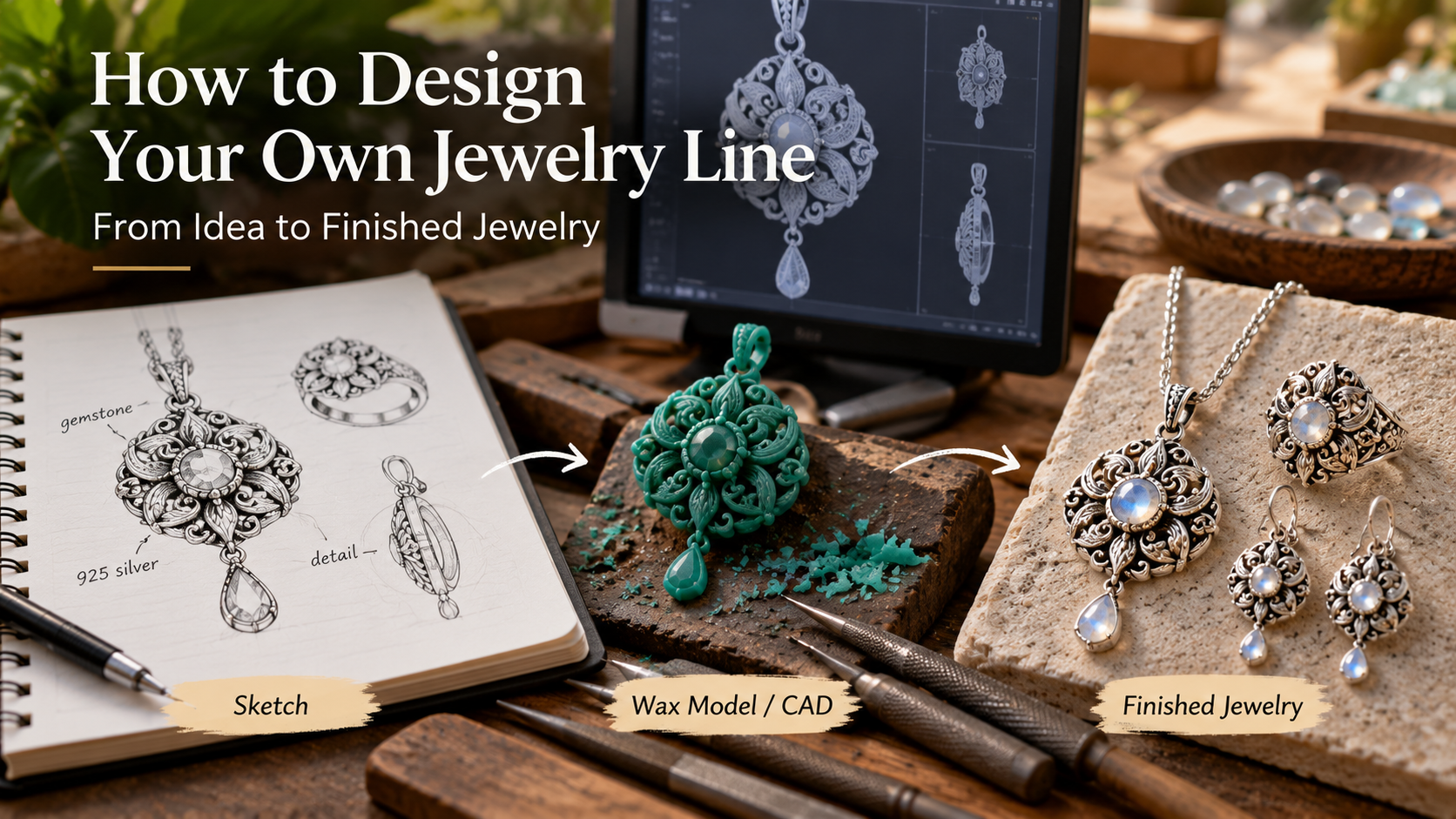
Starting your own jewelry line is an exciting opportunity to turn creative ideas into real products. However, designing jewelry is not simply about creating something beautiful. A successful design must also be comfortable to wear, durable, practical to manufacture, and suitable for your target market.
At Puri Lautan Mutiara, a custom jewelry manufacturer in Bali established in 1998, we have worked with many designers and jewelry brands to transform their ideas into finished products.
Over the years, we have learned that some of the most challenging designs are not necessarily the most complicated-looking pieces. Sometimes, a beautiful sketch requires significant adjustments before it can be manufactured efficiently.
If you are planning to launch your own jewelry collection, here are some practical considerations that can help you avoid unnecessary costs and develop better products.
1. Start with Research Before Creating Your Designs
Every successful jewelry collection begins with research.
Before sketching your first design, take time to understand the type of jewelry you want to create and the customers you want to reach.
Consider these questions:
- Who is your target customer?
- Are you designing everyday jewelry or statement pieces?
- What materials and finishes will you use?
- What retail price range are you targeting?
- What makes your collection different from existing products?
Researching jewelry trends and existing collections can help you understand what customers are already buying.
However, research should be used for inspiration, not copying.
Look for opportunities to improve functionality, proportions, comfort, materials, or decorative details while developing your own distinctive design identity.
Our advice: A unique design is valuable, but uniqueness alone does not guarantee that a piece will be commercially successful.
2. Balance Creativity with Practical Manufacturing
One of the most common challenges we encounter is receiving a beautiful jewelry design that is difficult or expensive to manufacture.
A highly detailed design may require additional labor, specialized tools, multiple components, or complicated assembly.
In some cases, delicate decorative elements may also make the finished jewelry fragile or uncomfortable to wear.
For example, a ring with very thin decorative sections may look elegant in a drawing but could bend during normal use.
Similarly, an oversized earring may look attractive in a photograph but feel uncomfortable if its weight is not considered.
This does not mean designers should avoid creativity.
Instead, it means that good jewelry design combines appearance, functionality, and manufacturing feasibility.
Working with an experienced jewelry manufacturer during the development stage can help identify potential problems before expensive samples are produced.
3. Design Components That Can Be Used Across Multiple Products
One of our favorite recommendations for new jewelry brands is to develop versatile design components.
Imagine you want to launch a collection inspired by starfish.
Rather than designing a completely different starfish for every jewelry item, consider creating one well-proportioned starfish component that can be adapted for several products.
For example, the same decorative component might be used for:
- A pair of earrings.
- A necklace pendant.
- A bracelet charm.
- A decorative ring element.
You may need to adjust the size, thickness, or attachment points for different applications, but the basic design can remain consistent.
This approach offers several advantages.
First, it creates a recognizable visual identity across your collection.
Second, it may reduce the number of original masters and molds required.
Third, it can simplify future product development and repeat production.
For a startup jewelry brand with a limited development budget, this can be particularly valuable.
4. Choose the Right Materials for Your Jewelry Collection
Material selection affects the appearance, durability, weight, and manufacturing cost of jewelry.
Some common materials include:
Sterling Silver 925
A popular choice for custom jewelry because of its appearance, versatility, and suitability for many fabrication and casting techniques.
Brass
An alternative material for selected designs, especially where a warm, golden metal color or gold-plated finish is desired.
Gold
Suitable for fine jewelry collections, although manufacturing methods and material costs differ significantly from those of silver or brass.
Gemstones and Decorative Materials
Natural gemstones, cubic zirconia, mother-of-pearl, abalone shell, and other decorative materials can add color and character to a design.
When choosing materials, consider not only the desired appearance but also the target retail price and intended use.
For example, a large pendant made entirely from sterling silver may be considerably more expensive than a smaller or differently constructed version.
The right material choice can help maintain your design concept while keeping the product within your intended price range.
5. Understand the Difference Between Handmade Jewelry and Casting
Not every jewelry design should be manufactured using the same technique.
Some designs are better suited to traditional hand fabrication, while others can be produced more efficiently through lost-wax casting.
Handmade Jewelry
Hand fabrication is particularly useful for certain constructions, decorative techniques, and one-of-a-kind designs.
It may involve cutting, shaping, soldering, forming, and assembling metal components by hand.
However, producing many identical pieces entirely by hand can require considerable labor.
Lost-Wax Casting
Lost-wax casting is often suitable for jewelry with detailed shapes or components that need to be reproduced consistently.
The process typically involves creating a master model, preparing a mold where appropriate, producing wax patterns, and casting the design in metal.
For repeat production, this can be more efficient than making each component individually by hand.
However, casting is not suitable for every design without modification.
Very thin sections, difficult metal flow paths, and certain complex structures may need to be adjusted.
The best manufacturing method depends on the design itself, not simply the quantity ordered.
6. Plan Your Production Quantity Before Finalizing the Design
Production quantity is an important factor that many new jewelry designers overlook.
Are you planning to produce five pieces, twenty pieces, fifty pieces, or several hundred?
The answer can influence the manufacturing method and initial development cost.
For example, creating a master and production mold involves an initial investment.
If you only need a single piece, a handmade approach may sometimes be more practical.
If you intend to reproduce the same design regularly, developing a suitable master and mold may offer better long-term value.
However, there is no universal quantity at which casting automatically becomes the best option.
A complex design may require casting even for a small order, while a simple fabricated design may remain economical at higher quantities.
Our recommendation: Discuss your estimated production quantity with your manufacturer before approving the final design.
This allows the manufacturing process to be considered from the beginning.
7. Understand Why Some Jewelry Designs Require Setup Costs
New jewelry designers sometimes wonder why manufacturers charge setup fees before production begins.
The reason is that turning a design into a reproducible product may require work beyond manufacturing the finished jewelry itself.
Depending on the design, development may include:
- Creating or refining a master model.
- Wax carving or CAD modeling.
- Producing a rubber or silicone mold.
- Testing casting and assembly methods.
- Adjusting dimensions or construction.
- Preparing the design for repeat production.
Consider a ring featuring a detailed dragon carving.
Carving the entire design directly into a finished silver ring could require substantial specialized labor.
An alternative may be to carve the dragon in wax or create a digital model, then use casting to reproduce the shape.
Even if the first order is relatively small, this approach may be more practical and cost-effective.
The setup cost helps cover the work required to prepare the design for manufacturing.
It is therefore important to consider development costs separately from the unit price of the finished jewelry.
8. Prepare Clear Jewelry Design Specifications
You do not necessarily need professional CAD software to begin developing a jewelry collection.
A hand-drawn sketch can be a useful starting point.
However, the more information you provide, the easier it becomes for a manufacturer to understand your expectations.
Useful specifications include:
- Front, side, and back views of the design.
- Overall dimensions in millimeters.
- Intended metal and surface finish.
- Gemstone type, size, shape, and quantity.
- Ring sizes or chain lengths where applicable.
- Preferred construction and fastening details.
- Estimated order quantity.
- Reference photographs showing specific details.
If you have a CAD file or technical drawing, that can also be helpful.
For complicated designs, additional discussion may be required to determine the most practical construction.
Remember that a reference photograph is not always enough to produce an accurate quotation.
Dimensions, material specifications, and construction details can significantly affect the final cost.
9. Develop Samples Before Starting Bulk Production
Sampling is one of the most important stages of custom jewelry manufacturing.
A design may look excellent on paper but feel different once it becomes a physical object.
A sample allows you to evaluate:
Appearance: Are the proportions and decorative details correct?
Comfort: Is the jewelry suitable for everyday wear?
Weight: Is the piece too heavy or too light for its intended purpose?
Construction: Are the joints, clasps, settings, and other components practical?
Finishing: Does the polishing, oxidation, or plating match the intended design?
Cost: Can the design be manufactured at a price that supports your business?
Some samples require adjustments before they are ready for production.
This is a normal part of jewelry development.
Making corrections at the sampling stage is generally preferable to discovering problems after a larger quantity has been manufactured.
10. Consider Your Retail Price and Profit Margin
Jewelry designers sometimes focus heavily on the appearance of a product without calculating whether it will be commercially viable.
Before launching your collection, establish a realistic target retail price.
Then consider the costs involved in bringing the product to market.
These may include manufacturing, sampling, packaging, shipping, import duties, marketing, platform fees, and other business expenses.
For example, a design that is expensive to manufacture may leave insufficient margin if your target customer expects an affordable retail price.
In some cases, small adjustments to the design can help.
Reducing unnecessary metal weight, simplifying assembly, or using shared components across several products may improve manufacturing efficiency.
The objective is not always to produce the cheapest jewelry.
It is to create a product whose quality, design, and cost are appropriate for your intended market.
11. Build a Collection Rather Than Isolated Designs
A jewelry collection should feel connected.
This does not mean every item must look identical.
Instead, the designs should share recognizable characteristics, such as a particular texture, decorative motif, gemstone palette, or overall style.
For example, a collection inspired by ocean life might include starfish, shells, and wave patterns.
These elements can be used across earrings, rings, pendants, and bracelets while maintaining a consistent identity.
A coordinated collection can also make product photography, branding, and marketing more effective.
For new jewelry brands, starting with a small, carefully developed collection is often more manageable than launching many unrelated designs at once.
12. Work with Your Jewelry Manufacturer Early
One of the best ways to avoid unnecessary development expenses is to involve your manufacturer before every design detail is finalized.
An experienced manufacturer can provide feedback on material selection, dimensions, production techniques, and potential construction issues.
For example, a manufacturer may recommend:
- Increasing the thickness of a delicate section.
- Changing an attachment point for better durability.
- Producing certain components separately.
- Using casting instead of hand fabrication.
- Simplifying an unnecessarily complicated construction.
These recommendations should not be viewed as restrictions on creativity.
They are part of turning a creative concept into a practical, wearable product.
Good communication between the designer and manufacturer can save time and reduce avoidable revisions.
Custom Jewelry Design and Manufacturing in Bali
At Puri Lautan Mutiara, we help jewelry designers, brands, and wholesalers develop custom jewelry collections.
Based in Singapadu, Gianyar, Bali, our company combines traditional silversmithing experience with selected modern production techniques.
We work with sterling silver, brass, and other suitable materials depending on the design requirements.
Whether you have a simple sketch, detailed technical drawin