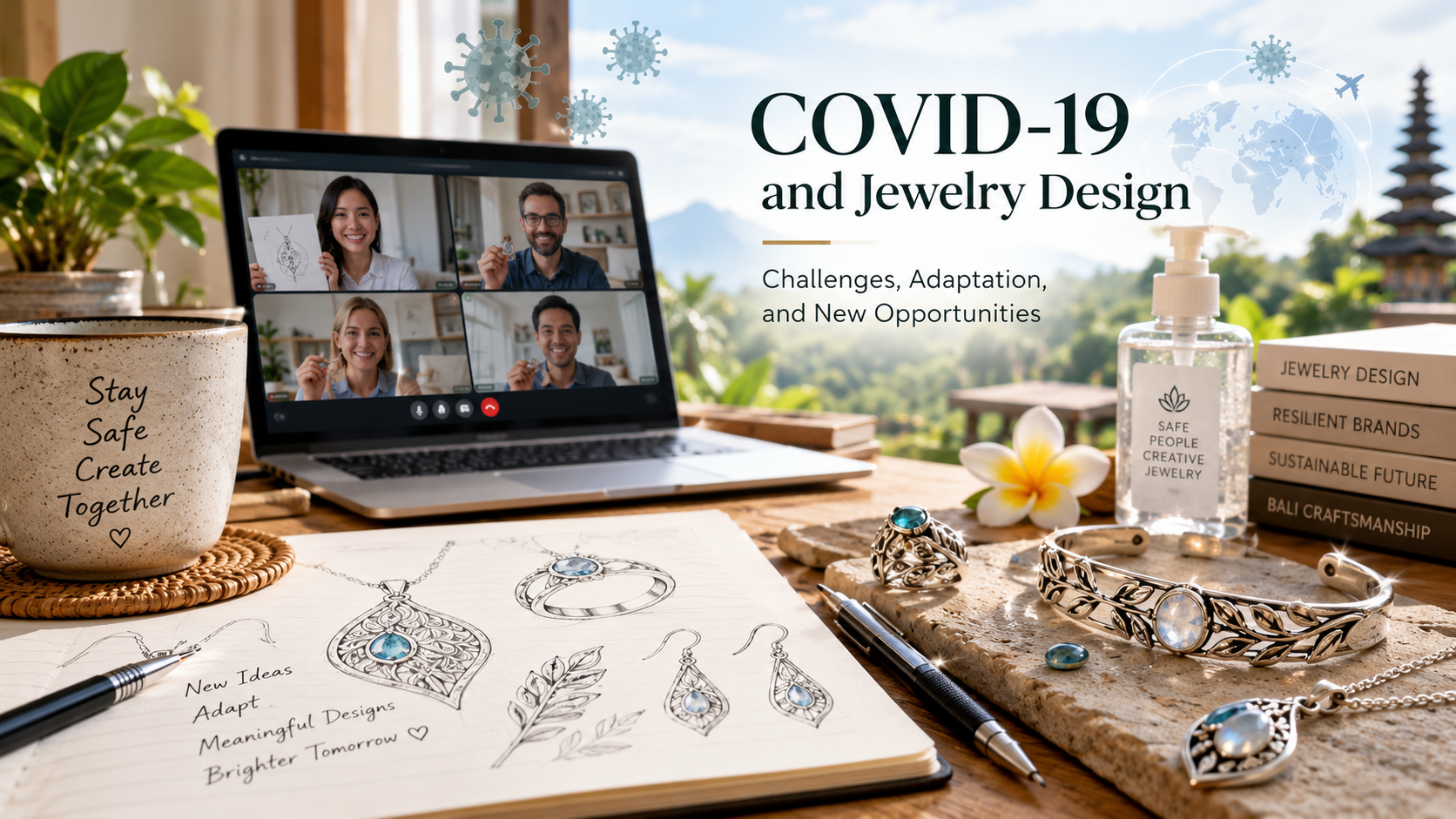
The COVID-19 pandemic changed the world in ways few businesses could have anticipated. For the jewelry industry, the impact was particularly challenging. Retail stores closed, international travel stopped, consumer spending shifted, and jewelry manufacturers faced cancellations and uncertain production schedules.
At Puri Lautan Mutiara, a Bali-based jewelry manufacturer established in 1998, we experienced these challenges firsthand.
Looking back, the pandemic was not only a difficult period for our business. It also changed how jewelry designers, manufacturers, and retailers approached creativity, communication, and international business relationships.
When Jewelry Orders Suddenly Stopped
In early 2020, our jewelry manufacturing business began experiencing a noticeable slowdown.
The situation became even more difficult when COVID-19 reached Indonesia in March 2020.
Some customers canceled their orders, while others postponed production because they were uncertain about the future of their businesses.
For a jewelry manufacturer serving international customers, this created a challenging situation.
Production planning became difficult, and there was no clear indication of when business would return to normal.
However, not everything stopped.
Some customers continued developing new jewelry samples, even when they were not ready to place bulk orders.
This became an important reminder that creativity and product development do not necessarily have to stop during an economic crisis.
How COVID-19 Affected Jewelry Manufacturers in Bali
Bali is internationally recognized for its traditional silver craftsmanship, particularly in areas such as Celuk and Singapadu.
Many jewelry workshops depend on orders from overseas designers, wholesalers, and retailers.
During the pandemic, the industry faced several challenges:
- Reduced international jewelry orders.
- Canceled or postponed production.
- Disruptions to international shipping.
- Limited opportunities for customers to visit workshops.
- Financial pressure on local silversmiths and small manufacturing businesses.
For skilled artisans who depend on regular production work, reduced orders also meant reduced income opportunities.
The pandemic demonstrated how closely connected Bali’s jewelry industry had become to the global economy.
Finding Inspiration During Difficult Times
When regular production slowed, we found ourselves spending more time researching jewelry designs, exploring ideas, and observing how other designers responded to the situation.
One particularly unusual trend was jewelry inspired by the coronavirus itself.
Some designers experimented with pendants, charms, and decorative objects resembling the distinctive spherical shape of the virus.
At first, the concept seemed strange.
Why would someone want to wear jewelry inspired by a virus responsible for so much suffering?
However, jewelry has always reflected human experiences, including difficult historical events.
Some pieces were intended as artistic commentary, while others represented memories of an extraordinary period.
Although such designs were not necessarily suitable for everyone, they demonstrated how designers could find creative inspiration even in unexpected circumstances.
COVID-19 Inspired Jewelry Designs
The coronavirus became one of the most recognizable visual symbols of 2020.
Its rounded shape and protruding spike-like structures inspired various artistic interpretations.
From a jewelry design perspective, these forms could be recreated using traditional hand fabrication, lost-wax casting, or modern CAD technology.
Interestingly, spherical and textured jewelry designs existed long before the pandemic.
For example, traditional Balinese Dream Ball pendants feature rounded forms, decorative metalwork, and intricate patterns.
Some of these designs may share superficial visual similarities with virus-inspired jewelry, although their origins and meanings are entirely different.
The Bali Dream Ball has its own traditional decorative identity and should not be confused with jewelry specifically created to represent COVID-19.
This comparison illustrates an interesting aspect of jewelry design: similar shapes can carry completely different meanings depending on their cultural and historical context.
The Rise of Remote Jewelry Design and Development
One lasting change from the pandemic was the increasing importance of remote collaboration.
Before COVID-19, many international jewelry buyers preferred visiting workshops, reviewing samples in person, and discussing production directly with manufacturers.
Travel restrictions made those visits difficult or impossible.
As a result, communication through email, video calls, digital photographs, and online messaging became even more important.
Jewelry designers could share sketches, technical drawings, and CAD files without traveling to the manufacturing location.
Manufacturers could then review designs, suggest technical improvements, and develop physical samples for approval.
Although remote jewelry manufacturing already existed before the pandemic, COVID-19 encouraged businesses to rely more heavily on these methods.
Today, remote collaboration remains an important part of international jewelry production.
Why Jewelry Sampling Remained Important
Even during periods of reduced demand, sample development remained valuable.
Developing a new jewelry collection takes time.
Designs must be reviewed, materials selected, manufacturing methods evaluated, and samples produced before bulk production can begin.
For some jewelry brands, the slowdown provided an opportunity to prepare new collections for future launches.
Rather than concentrating entirely on immediate sales, designers could spend more time refining their products.
This approach also helped maintain some production activity for manufacturers during an otherwise difficult period.
At Puri Lautan Mutiara, sample development has always been an important part of our custom jewelry manufacturing services.
A well-developed sample helps establish the design, dimensions, materials, construction, and finishing standards before larger quantities are produced.
Lessons the Jewelry Industry Learned From COVID-19
Looking back, the pandemic highlighted several lessons that remain relevant today.
Business flexibility matters.
Manufacturers and jewelry brands need to adapt when market conditions change unexpectedly.
Communication is essential.
When customers cannot visit a workshop, clear communication, accurate specifications, and regular production updates become even more important.
Product development should continue when possible.
A slowdown can provide time to research new ideas, improve existing designs, and prepare future collections.
Skilled craftsmanship remains valuable.
Technology can improve communication and design development, but experienced artisans are still essential for many jewelry manufacturing processes.
Long-term relationships are important.
A reliable relationship between a jewelry brand and its manufacturer can help both parties navigate periods of uncertainty.
Jewelry Manufacturing After the Pandemic
The jewelry industry has continued to evolve since the pandemic.
Online communication, digital design tools, and remote production management are now familiar parts of the manufacturing process.
Customers can begin developing collections by sending sketches, reference photographs, CAD files, or detailed design specifications.
However, successful jewelry production still requires careful technical review, sampling, quality control, and cooperation between designers and manufacturers.
At Puri Lautan Mutiara, we continue to combine traditional Balinese craftsmanship with modern jewelry development methods to serve international jewelry brands, designers, and wholesalers.
Our experience during COVID-19 reinforced the importance of adaptability, clear communication, and maintaining long-term business relationships.
Final Thoughts: Creativity Beyond a Crisis
The COVID-19 pandemic was one of the most difficult periods experienced by many businesses, including jewelry manufacturers in Bali.
Orders declined, production became uncertain, and skilled artisans faced significant challenges.
Yet even during that difficult time, creativity continued.
Some designers experimented with unusual concepts, others developed new collections, and manufacturers explored different ways to collaborate with customers overseas.
The experience reminded us that jewelry is more than a commercial product.
It can also reflect history, personal experiences, artistic expression, and the resilience of the people who create it.
At Puri Lautan Mutiara, we remain committed to supporting jewelry designers and brands through custom manufacturing, sample development, and traditional Balinese craftsmanship.
If you are planning a new jewelry collection, visit our Custom Jewelry Design and Development page or contact us to discuss your project.
Puri Lautan Mutiara — Bali Jewelry Manufacturer Since 1998.