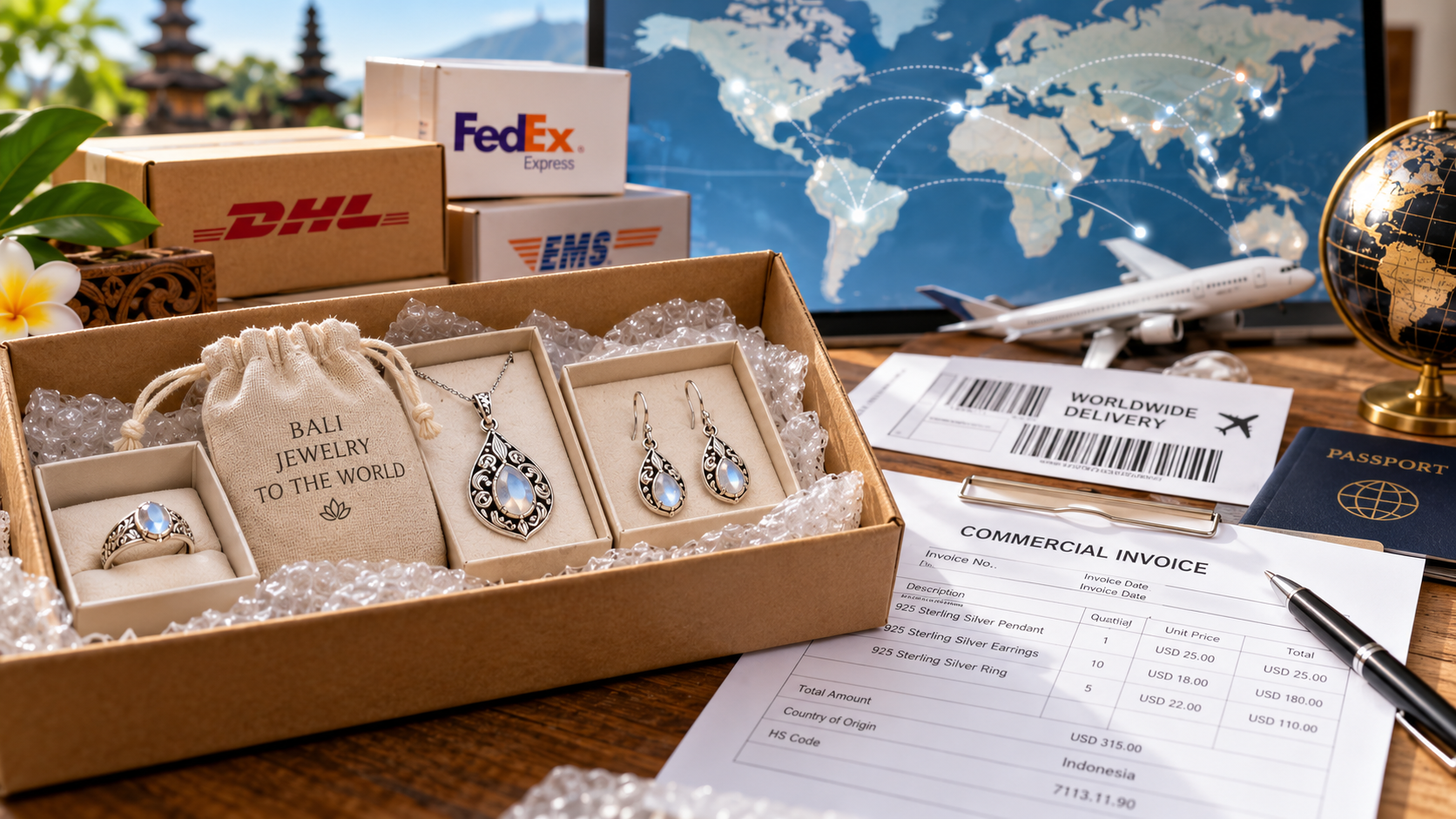
Shipping jewelry internationally requires more than choosing a courier and placing the products inside a box.
Jewelry may be small and lightweight, but it can be valuable, delicate, and subject to special shipping restrictions. For jewelry brands, retailers, and manufacturers, a successful shipment depends on appropriate packaging, accurate documentation, reliable transportation, and a clear understanding of customs procedures.
At Puri Lautan Mutiara, a Bali jewelry manufacturer established in 1998, international shipping is an important part of our business. We work with overseas jewelry designers, brands, and wholesalers who need their samples and production orders delivered safely.
Over the years, we have learned that understanding the shipping process can help prevent unnecessary delays, unexpected costs, and avoidable problems.
Here are some important considerations when shipping jewelry internationally.
1. Understand the Jewelry You Are Shipping
Before selecting a shipping company, identify the materials, value, and construction of the jewelry.
Not all jewelry presents the same shipping risks.
A simple sterling silver ring is relatively compact and easy to protect. A delicate necklace with fine chains, multiple dangling components, or fragile gemstones may require more careful packaging.
Consider the following:
- Material: Sterling silver, brass, gold, gemstones, or mixed materials.
- Construction: Solid pieces, delicate chains, soldered components, or intricate settings.
- Quantity: Individual samples or bulk production orders.
- Value: The actual commercial value of the shipment.
- Destination: The importing country’s regulations and documentation requirements.
These factors influence packaging, courier eligibility, insurance, and customs clearance.
2. Choose the Right Shipping Company
There are several ways to ship jewelry internationally, including postal services, express couriers, and specialized logistics providers.
Each option has advantages and limitations.
International Express Couriers
Express courier services may provide detailed tracking, customs brokerage support, and relatively fast delivery.
However, jewelry is not automatically accepted by every courier service.
Acceptance may depend on the material, declared value, destination, and the courier’s specific policy.
Some carriers require advance approval for precious-metal jewelry or high-value shipments.
Postal and EMS Services
Postal services may offer economical international shipping options.
However, transit times, tracking coverage, insurance availability, and permitted contents can vary significantly by destination.
For valuable jewelry, it is important to verify the service’s restrictions and compensation limits before dispatch.
Specialized Jewelry Shipping
For particularly valuable jewelry, specialized logistics services may provide additional security and coverage.
These services may be more expensive, but they can be worth considering when standard courier terms are unsuitable.
Our recommendation: Never assume that a courier accepting ordinary merchandise will also accept sterling silver or gold jewelry. Confirm the specific shipment with the carrier before booking.
3. Do Not Choose Shipping Based on Price Alone
Shipping cost is important, particularly for small jewelry orders.
However, the cheapest shipping method is not always the best option.
Consider the complete service rather than the transportation price alone.
A suitable shipping service should offer an appropriate balance of:
- Transit time.
- Tracking visibility.
- Customs handling.
- Security.
- Insurance or shipment protection.
- Destination coverage.
- Reliability and customer support.
For inexpensive items, a lower-cost shipping service may be appropriate if the contents are permitted and the risk is acceptable.
For high-value jewelry, additional security and appropriate insurance may be more important than saving a small amount on freight.
There is no universal percentage of the merchandise value that should be allocated to shipping.
The appropriate shipping budget depends on the value, quantity, destination, urgency, and risk of the order.
4. How to Pack Jewelry for International Shipping
Proper packaging is essential, even when the jewelry itself is made from durable metal.
Some pieces can be scratched, bent, tangled, or damaged during transportation.
Protect Each Jewelry Item Individually
Use suitable pouches, protective sleeves, or individual compartments to prevent jewelry from rubbing against other pieces.
Fine chains should be secured to minimize tangling.
Earrings with delicate hooks or dangling components should be protected from bending.
Protect Gemstones and Decorative Elements
Gemstones, mother-of-pearl, abalone, and other decorative materials may require additional cushioning.
The packaging should prevent pressure from being applied directly to vulnerable settings or components.
Use a Strong Outer Box
Place the jewelry inside protective inner packaging, then use a sturdy outer shipping box.
Fill empty spaces with suitable cushioning materials so that the contents cannot move excessively during transit.
Avoid Advertising Valuable Contents
The outside of the parcel should not unnecessarily advertise that it contains valuable jewelry.
However, the shipping documents must still describe the goods accurately.
Photograph the Shipment
Before sealing the parcel, take photographs showing the jewelry, protective packaging, and final packed condition.
These records may be useful if a shipment is damaged or a claim must be submitted.
5. Shipping Gold and Other High-Value Jewelry
Gold jewelry deserves special attention because of its value and the restrictions imposed by some transportation providers.
We generally recommend selecting a shipping service specifically authorized to transport the type and value of jewelry involved.
Before dispatch, confirm:
- Whether the courier accepts gold or precious-metal jewelry.
- Whether advance approval is required.
- The maximum permitted shipment value.
- Whether the destination is eligible.
- What insurance or shipment protection is available.
- Which documents must accompany the parcel.
It is also important to distinguish finished gold jewelry from gold bullion or loose precious metals. Couriers may apply different rules to these categories.
For high-value shipments, request written confirmation of acceptance and coverage whenever possible.
6. Prepare Accurate Customs Documentation
Customs documentation is one of the most important parts of international jewelry shipping.
An incomplete or inaccurate invoice can result in delays, requests for clarification, additional charges, or shipment rejection.
A commercial invoice should normally include:
- Shipper and consignee details.
- Invoice number and date.
- Clear product descriptions.
- Metal composition and relevant material information.
- Quantity and unit price.
- Total declared value and currency.
- Country of origin.
- Applicable Harmonized System (HS) codes.
- Shipping terms and other information required for the destination.
For example, “925 sterling silver earrings with natural gemstones” is more informative than simply writing “accessories.”
Likewise, a gold-plated brass necklace should be described as such rather than incorrectly declared as solid gold jewelry.
The description must accurately represent the actual goods.
7. Understand HS Codes for Jewelry
The Harmonized System, or HS, is an internationally used classification system for traded goods.
Jewelry products are generally classified within Chapter 71, although the exact code depends on their composition and characteristics.
For example, sterling silver jewelry and imitation jewelry may fall under different tariff classifications.
The correct code can affect customs duties, import procedures, and required documentation.
Because countries may use additional tariff digits beyond the internationally harmonized portion, exporters and importers should verify the applicable classification for the destination.
A manufacturer can provide material and product information, but the final customs classification should be confirmed using the relevant official tariff guidance or a qualified customs professional.
8. Jewelry Samples Must Also Be Declared Correctly
Jewelry designers often send samples to manufacturers for evaluation, reproduction, repair, or development.
Manufacturers may also send newly developed samples to customers for approval.
It is important to understand that a sample shipment is not automatically exempt from customs duties or taxes.
The customs treatment depends on the destination country’s rules and the actual purpose of the shipment.
A sample should be described accurately, for example:
Sterling silver jewelry samples for design evaluation — not for resale.
The declared value should comply with applicable customs valuation rules, even when the goods are supplied without charge.
Do not describe commercial jewelry samples as personal gifts merely to obtain more favorable customs treatment.
For temporary imports, repairs, or goods intended to be returned, special customs procedures may be available depending on the countries involved.
These arrangements should be confirmed before shipping.
9. Who Pays Import Duties and Taxes?
International buyers sometimes assume that shipping charges include import duties and taxes.
However, transportation charges and import charges are separate unless a particular shipping arrangement explicitly includes both.
Two commonly used delivery terms are:
DAP — Delivered at Place
Under DAP arrangements, the seller is generally responsible for delivering the goods to the agreed destination, while the buyer handles import clearance and applicable import duties and taxes.
DDP — Delivered Duty Paid
Under DDP arrangements, the seller takes responsibility for import clearance and applicable duties and taxes, subject to the agreed contract and the legal requirements of the importing country.
Not every courier, destination, or transaction supports DDP in the same way.
Before confirming an order, both parties should agree on who is responsible for freight, import charges, customs clearance, and any additional fees.
Clear terms can prevent disputes when the shipment arrives.
10. Why Jewelry Shipments Sometimes Experience Customs Delays
Even a correctly prepared shipment may be selected for customs inspection.
Common reasons for delays include:
- Incomplete commercial invoices.
- Incorrect or unclear product descriptions.
- Questions about the declared value.
- HS code discrepancies.
- Missing importer information.
- Additional product compliance requirements.
- Random or risk-based customs inspections.
Different countries may also impose requirements concerning precious-metal markings, product safety, material restrictions, or other regulations.
If customs requests additional information, the shipper or importer may need to provide documents such as material declarations, proof of payment, product photographs, or manufacturing statements.
A reliable courier can assist with communication, but the customs authority makes the final clearance decision.
11. Can Different Shipping Companies Handle the Same Parcel?
Yes. International shipping networks sometimes involve multiple transportation partners.
A parcel booked through one provider may be handled by another company for a particular transportation segment or final delivery.
This can occur because of commercial partnerships, local delivery arrangements, or differences in network coverage.
As a result, the company delivering the parcel may not always be the same company that originally accepted it.
When comparing shipping options, ask about tracking continuity, final delivery arrangements, and who will assist if a problem occurs.
12. Is Shipping Insurance Necessary?
Shipping insurance or additional shipment protection is worth considering, especially for valuable jewelry.
However, it is important to understand the difference between:
- The value declared for customs.
- The value declared for carriage.
- The amount actually covered under an insurance policy.
These amounts do not necessarily provide the same protection.
A courier may accept a shipment but exclude certain jewelry categories from standard compensation.
Some policies also exclude particular gemstones, precious metals, or high-value goods.
Before purchasing coverage, confirm that the specific jewelry is eligible and review the compensation limits, exclusions, deductibles, and claims procedures.
Retain your commercial invoice, packing photographs, shipping records, and proof of value.
13. Tracking and Receiving International Jewelry Shipments
Once the parcel has been dispatched, share the tracking number with the recipient.
Both parties should monitor the shipment, particularly when it approaches customs clearance.
If the courier requests additional documentation, responding promptly may help avoid unnecessary delays.
Upon delivery, the recipient should inspect the external packaging before opening it.
If there is visible damage, document the condition immediately and follow the courier’s reporting procedure.
The jewelry should then be checked against the invoice or packing list.
Any missing or damaged items should be reported as soon as possible, within the applicable carrier deadlines.
14. International Jewelry Shipping from Bali
Bali has a long tradition of jewelry manufacturing, and many local workshops supply international jewelry designers and brands.
At Puri Lautan Mutiara, shipping is the final stage of a process that begins with design development, sampling, and production.
Before dispatch, we coordinate the order details, packaging, and available shipping arrangements with our customers.
Because every destination and jewelry collection can have different requirements, we review the shipping options according to the products and circumstances involved.
Our objective is to help customers receive their jewelry with clear documentation and suitable packaging.
Frequently Asked Questions About Shipping Jewelry
Can sterling silver jewelry be shipped internationally?
Yes, through services that accept it. Carrier policies vary, and some networks restrict precious-metal jewelry. Always verify acceptance before dispatch.
Is express shipping always safer than postal shipping?
Not necessarily. Safety depends on the service, packaging, tracking, security procedures, and coverage. Express shipping may offer advantages, but the exact service terms matter.
Do jewelry samples require a customs invoice?
International sample shipments generally require an appropriate customs declaration or invoice. Requirements vary by country and service.
Can I declare jewelry as a gift to avoid import taxes?
No. Commercial goods should not be misrepresented as gifts. The shipment must be declared according to its actual contents and purpose.
Does shipping insurance cover all jewelry?
No. Coverage depends on the carrier, product category, declared value, and policy conditions.
Who pays customs duties?
That depends on the agreed shipping terms and the destination country’s rules. Buyers and sellers should confirm responsibility before shipping.
Final Thoughts
International jewelry shipping is an important part of the relationship between manufacturers, designers, and retailers.
Although jewelry parcels are often small, they require careful attention to packaging, carrier restrictions, customs documentation, declared value, and insurance.
The best shipping method is not necessarily the fastest or cheapest. It is the method that provides suitable protection, clear procedures, and dependable delivery for the specific jewelry being transported.
At Puri Lautan Mutiara, we understand that successful jewelry manufacturing does not end when production is complete. Preparing finished products for international delivery is also part of serving our customers.
Planning a custom jewelry collection for your brand?
Learn more about our Custom Jewelry Manufacturing Services or contact Puri Lautan Mutiara to discuss your project and shipping requirements.
Puri Lautan Mutiara — Custom Jewelry Manufacturing in Bali Since 1998.
Further Reading
For current shipping restrictions and customs documentation guidance, consult the relevant courier and customs authorities:
- DHL Express Indonesia — What Can I Ship?
- DHL Express — Global Customs Customer Guidelines
- FedEx Jewelry Shipping Program
Shipping policies, insurance coverage, customs regulations, and import charges may change. Always verify the requirements for your specific products and destination before dispatch.