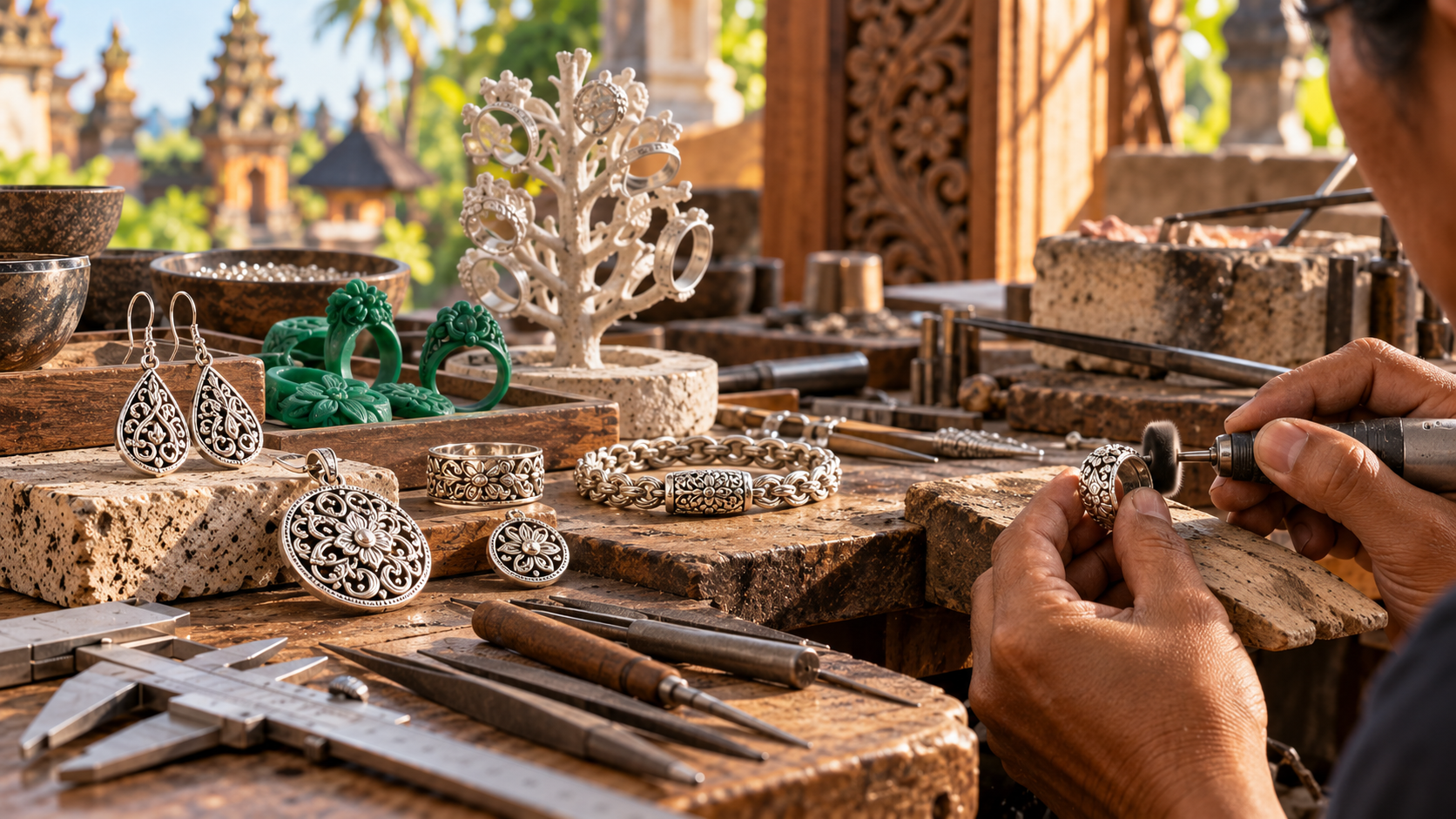
Bali, Indonesia, has a long history of silver jewelry craftsmanship. For generations, local silversmiths have created beautiful ornaments using traditional techniques. Today, their skills support a growing industry that serves both local and international markets.
Silver jewelry production in Bali combines traditional craftsmanship with modern manufacturing technology. As a result, jewelry workshops can produce everything from intricate Balinese designs to contemporary minimalist collections.
Moreover, many manufacturers now use computer-aided design (CAD), 3D printing, and lost-wax casting. These methods help improve production accuracy while preserving traditional metalworking skills.
However, creating quality sterling silver jewelry involves more than selecting a design. Each piece passes through several important production stages, from initial development to final inspection.
In this guide, we explain how silver jewelry is made in Bali. We also explore manufacturing techniques, production costs, minimum order quantities, and quality control. Finally, we discuss how international jewelry brands can work with local manufacturers to develop custom collections.
1. The History of Silver Jewelry Production in Bali
Silverworking has been part of Balinese artistic traditions for generations.
Historically, local metalworkers produced ceremonial objects, decorative ornaments, and jewelry associated with cultural and religious activities.
As tourism and international trade developed, Balinese craftspeople began producing a wider range of jewelry for commercial markets.
Celuk: Bali’s Traditional Silverworking Center
Celuk Village, located in Gianyar Regency, is widely recognized for its silver and gold craftsmanship.
Over time, families and workshops developed specialized skills in forming, soldering, casting, engraving, and decorative finishing.
The surrounding areas, including Singapadu and Sukawati, also became important parts of Bali’s jewelry production network.
Today, manufacturers across the region produce both traditional Balinese designs and contemporary jewelry for international customers.
2. What Makes Balinese Silver Jewelry Different?
Balinese jewelry is often associated with detailed metalwork and decorative surfaces.
Common design characteristics include:
- Intricate floral and ornamental patterns
- Granulation and bead-like silver details
- Oxidized finishes that emphasize recessed designs
- Hand-carved textures and organic shapes
- Traditional motifs adapted to contemporary jewelry
However, not every piece made in Bali follows a traditional style.
Many workshops also produce minimalist, geometric, and modern commercial jewelry based on customers’ specifications.
The ability to combine traditional skills with modern design is one of Bali’s important manufacturing strengths.
3. What Is 925 Sterling Silver?
Sterling silver contains 92.5% silver and 7.5% other metals, commonly copper.
Pure silver is relatively soft. Adding other metals improves hardness and makes the alloy more practical for many jewelry applications.
Sterling silver is widely used for rings, earrings, pendants, bracelets, necklaces, and decorative components.
Manufacturers should confirm alloy specifications before production.
A 925 stamp indicates a claim about silver content, but independent testing may be necessary when formal verification is required.
4. Step-by-Step Silver Jewelry Production in Bali
Different jewelry designs require different manufacturing methods.
Some pieces are entirely hand-fabricated, while others use casting, machining, or a combination of techniques.
The following stages describe a common custom jewelry manufacturing process.
Step 1: Design Development
The process begins with a design concept.
Customers may provide:
- Hand-drawn sketches
- Reference photographs
- Technical drawings
- CAD files or STL models
- Physical samples
- Product dimensions and target weights
The manufacturer reviews the design to determine whether it can be produced efficiently.
Important considerations include wall thickness, stone settings, construction, comfort, and finishing requirements.
Step 2: CAD Modeling or Hand-Carved Wax
For suitable designs, manufacturers create a digital model using CAD software.
CAD helps control dimensions, proportions, and technical details.
The digital model can then be used to produce a physical pattern through 3D printing.
Alternatively, skilled wax carvers may create models by hand.
Hand-carved wax remains useful for organic shapes, sculptural details, and traditional decorative designs.
Step 3: Master Model and Mold Making
Once the model is approved, the workshop may prepare a master model and reusable mold.
Rubber and silicone molds allow manufacturers to reproduce wax patterns for repeated casting.
Not every design requires a reusable mold. Some products are made individually or through direct fabrication.
Step 4: Wax Injection and Casting Tree Assembly
For designs using reusable molds, manufacturers inject wax to produce multiple copies of the jewelry pattern.
The wax patterns are connected to a central sprue to form a casting tree.
This arrangement allows several pieces to be cast in one production cycle.
Proper sprue placement helps molten metal flow into the mold and reduces casting defects.
Step 5: Investment and Burnout
The casting tree is placed inside a flask and surrounded by a specialized investment material.
After the investment sets, the flask enters a controlled heating cycle.
The heat removes the wax and prepares the mold for casting.
Temperature control is important because incomplete burnout or improper mold preparation can affect the final casting.
Step 6: Silver Casting
The manufacturer melts the appropriate silver alloy and introduces it into the prepared mold.
Workshops may use vacuum-assisted or centrifugal casting equipment.
After cooling, the investment is removed and the metal casting tree is cleaned.
The individual jewelry pieces are then separated from the sprues.
Step 7: Cleaning, Filing and Assembly
Fresh castings require additional work.
Jewelers remove sprue marks, correct surface imperfections, and refine the shapes.
Depending on the design, they may solder components, attach findings, or assemble moving parts.
Some products combine cast components with handmade silver sheet or wire.
Step 8: Gemstone Setting
Jewelry designs featuring gemstones require suitable settings.
Common techniques include:
- Bezel setting
- Prong setting
- Flush setting
- Pavé setting
- Channel setting
The appropriate method depends on gemstone dimensions, shape, durability, and the jewelry design.
Step 9: Polishing and Surface Finishing
Finishing strongly influences the appearance of sterling silver jewelry.
Popular finishes include high polish, satin, matte, brushed, hammered, and oxidized effects.
Traditional Balinese designs often use oxidation to emphasize decorative details.
Some products also receive gold plating or rhodium plating according to customer specifications.
Step 10: Quality Control and Packaging
Before shipping, the manufacturer inspects the finished products.
Quality-control checks may include:
- Metal specifications
- Dimensions and weight
- Ring sizes
- Surface finish
- Solder joints
- Gemstone security
- Clasp functionality
- Plating appearance
- Overall consistency with approved samples
After inspection, the jewelry is cleaned, packed, and prepared for delivery.
5. Handmade Jewelry vs Lost-Wax Casting
Both techniques have important roles in jewelry manufacturing.
| Factor | Hand Fabrication | Lost-Wax Casting |
|---|---|---|
| Main process | Cutting, shaping, soldering and assembly | Creating metal pieces from expendable patterns |
| Suitable designs | Wirework, sheet-metal forms, unique constructions | Detailed, repeatable and sculptural designs |
| Repeat production | Depends on design and tooling | Often efficient with reusable molds |
| Design flexibility | Strong for certain handmade constructions | Strong for detailed three-dimensional shapes |
| Finishing | Required | Required |
Many workshops combine both methods.
For example, a manufacturer may cast a decorative pendant and then attach a handmade bail or other fabricated components.
The best method depends on the design rather than a general assumption that handmade or cast jewelry is always superior.
6. How Much Does Silver Jewelry Production Cost in Bali?
There is no universal manufacturing price for sterling silver jewelry.
The cost depends on several factors.
Silver Weight
Metal weight directly influences material cost.
A heavy statement ring usually requires more silver than a lightweight pendant.
Design Complexity
Intricate patterns, moving parts, and difficult assemblies may require additional labor.
Production Quantity
Larger quantities can reduce certain setup costs per piece.
However, material costs still depend on metal weight and market prices.
Tooling and Development
CAD modeling, 3D printing, master models, and molds may involve separate development charges.
Gemstones and Components
Gemstone quality, size, setting requirements, and availability influence the quotation.
Surface Finishing
Specialized polishing, oxidation, engraving, or plating can increase production costs.
For meaningful price comparisons, buyers should provide the same technical specifications to each manufacturer.
7. Minimum Order Quantity for Custom Silver Jewelry
Minimum order quantity, or MOQ, is an important consideration for jewelry brands.
Some large manufacturers prefer higher production volumes, while smaller workshops may accept limited batches.
At PLM Bali, our typical MOQ starts at approximately 5–10 pieces per style or size, depending on the design and production requirements.
Small orders can be useful for testing new collections before committing to larger inventory quantities.
However, buyers should remember that sampling, tooling, and setup costs may increase the unit price of smaller orders.
8. How Long Does Custom Jewelry Production Take?
Lead times depend on design complexity, development requirements, materials, and production quantities.
A typical custom jewelry project may include design review, sampling, production, finishing, and quality control.
At PLM Bali, many standard custom production orders generally require around 4–6 weeks after the necessary approvals and arrangements are completed.
New product development, complicated designs, or specialized components may require additional time.
Buyers should confirm the production schedule before placing an order.
9. How to Choose a Reliable Silver Jewelry Manufacturer in Bali
Selecting a manufacturer requires more than comparing prices.
Review Manufacturing Capabilities
Ask whether the workshop offers the techniques required for your designs.
A supplier specializing in simple casting may not be suitable for complex mechanical jewelry.
Request Samples
Samples help buyers evaluate dimensions, finishing, craftsmanship, and communication.
Confirm Material Specifications
Ask about silver purity, gemstone materials, plating requirements, and relevant testing procedures.
Discuss Minimum Order Quantities
Confirm whether the MOQ applies per style, size, or variation.
Establish Quality Standards
Agree on measurable specifications and acceptable tolerances.
Understand Payment and Shipping Terms
Clarify deposits, production milestones, packaging, shipping arrangements, and import responsibilities.
Evaluate Communication
Reliable communication is particularly important for international manufacturing relationships.
A manufacturer should explain technical limitations, provide realistic schedules, and communicate important changes.
10. Custom Silver Jewelry Manufacturing at PLM Bali
PT Puri Lautan Mutiara (PLM Bali) has worked in jewelry manufacturing since 1998.
We operate as a small jewelry workshop in Singapadu, Gianyar, Bali, producing custom jewelry for international designers, retailers, and brands.
Our main manufacturing capabilities include:
- 925 sterling silver jewelry
- Brass and white brass jewelry
- Selected solid gold jewelry
- Lost-wax casting
- Hand-carved wax models
- CAD design support and 3D printing
- Mold making
- Soldering and assembly
- Gemstone setting
- Laser engraving
- Polishing and oxidized finishing
- Gold plating and rhodium plating
- OEM and ODM production
We work with customer designs and discuss each project’s technical requirements before production.
Our typical MOQ starts at approximately 5–10 pieces per style or size, and our general production lead time is around 4–6 weeks, subject to the project.
We do not claim to be the largest jewelry factory in Bali. Our focus is on practical manufacturing solutions, clear communication, and products that match our workshop’s capabilities.
For new inquiries, customers can share sketches, photographs, CAD files, dimensions, materials, and estimated order quantities.
Learn more about PLM Bali or contact our workshop to discuss a custom jewelry project.
11. Responsible Silver Jewelry Manufacturing
Responsible production involves several considerations.
Material Efficiency
Manufacturers can reduce unnecessary material loss through appropriate design planning, casting procedures, and scrap recovery.
Recycled Silver
Recycled silver can be used in jewelry manufacturing when its composition and sourcing meet the project’s requirements.
Recycled sterling silver must still satisfy the same silver purity specifications as other sterling silver.
Workplace Safety
Jewelry workshops should manage ventilation, chemical handling, protective equipment, and appropriate waste treatment.
Product Compliance
International jewelry brands may need to meet destination-market requirements concerning metal composition, restricted substances, labeling, and product safety.
Buyers should discuss these requirements with their manufacturers before production begins.
Frequently Asked Questions About Silver Jewelry Production in Bali
Why is Bali famous for silver jewelry?
Bali has a longstanding tradition of decorative metalworking, particularly in Celuk and surrounding areas of Gianyar. Local workshops combine traditional techniques with modern manufacturing methods.
Is Bali silver real sterling silver?
Jewelry made in Bali can use genuine 925 sterling silver, but buyers should confirm the composition of each product. Geographic origin alone does not establish metal purity.
Can I manufacture my own jewelry designs in Bali?
Yes. Many workshops accept custom designs from sketches, technical drawings, CAD files, or physical samples.
Can I order small quantities?
Some workshops accept small-batch orders. Minimum quantities vary depending on the manufacturer and design.
How long does jewelry manufacturing take in Bali?
Lead times vary. Standard repeat orders may be faster than complex custom projects that require development and sampling.
Can Bali manufacturers export jewelry internationally?
Yes. Many Bali jewelry manufacturers serve international markets. Shipping, customs documentation, and import requirements depend on the destination and product.
Conclusion
Silver jewelry production in Bali combines generations of craftsmanship with modern manufacturing technology.
From design development and wax carving to casting, gemstone setting, and polishing, each production stage contributes to the finished product.
For international jewelry brands, Bali offers opportunities to work with workshops that understand both traditional silverwork and contemporary design requirements.
The most important factor is choosing a manufacturing partner whose capabilities, quality standards, and communication match your project.
If you are planning a custom sterling silver jewelry collection, we welcome your inquiries.
Contact PLM Bali for Custom Jewelry Manufacturing
PT Puri Lautan Mutiara — Bali Jewelry Manufacturer Since 1998.