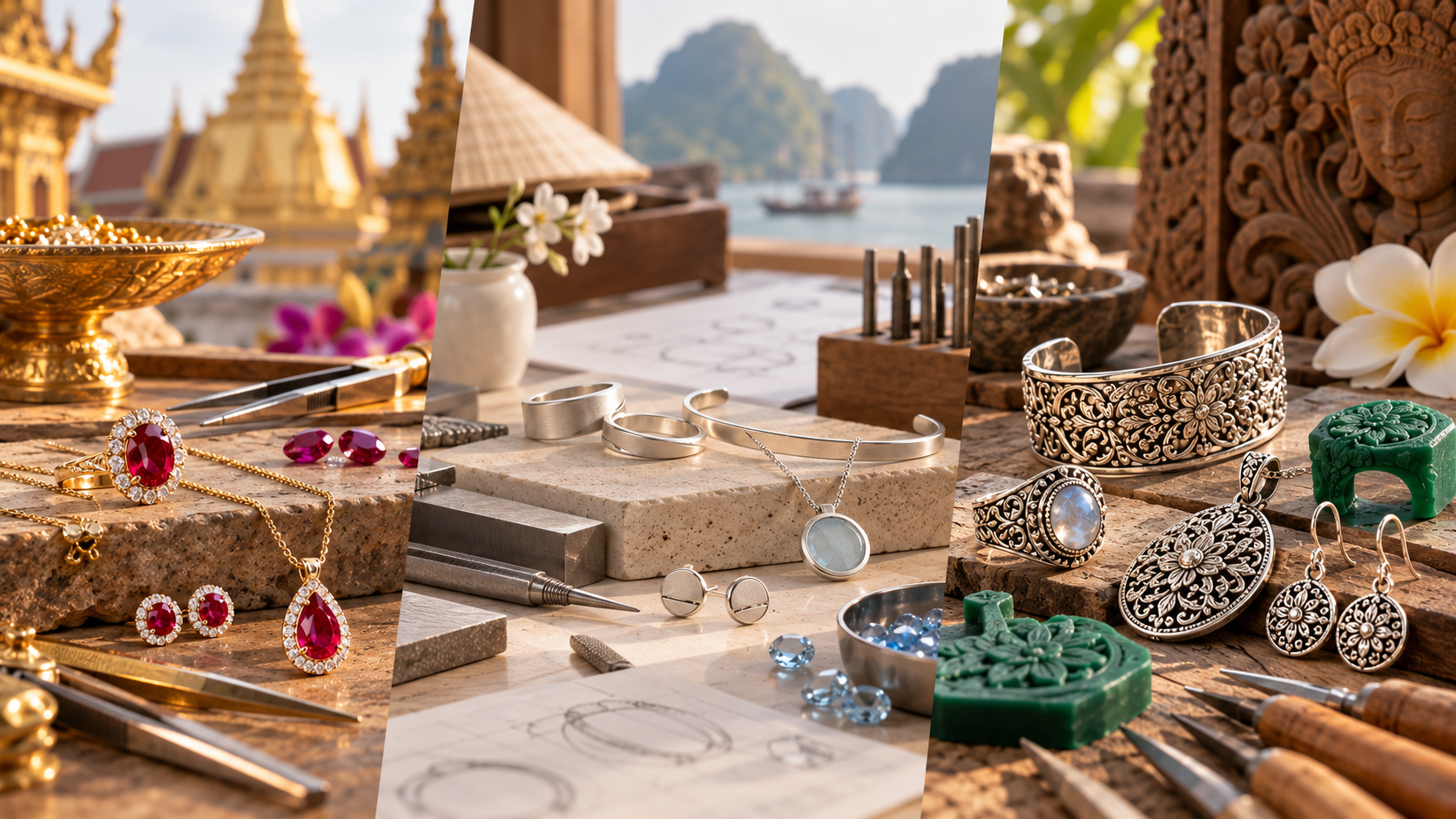
Southeast Asia has become an important sourcing region for international jewelry brands. Thailand, Vietnam, and Bali, Indonesia, offer different manufacturing environments, combining traditional craftsmanship with modern production capabilities.
For jewelry designers, retailers, and emerging brands, choosing the right manufacturing location can influence product quality, development costs, minimum order quantities, and long-term business growth.
However, no single destination is the best choice for every jewelry project.
Thailand offers an established gemstone and jewelry industry. Vietnam provides a range of manufacturing opportunities, while Bali has a strong tradition of artisanal silver jewelry and small-workshop production.
This guide compares jewelry manufacturing in Thailand, Vietnam, and Bali, helping brands evaluate their sourcing options based on practical production requirements.
1. Jewelry Manufacturing in Thailand
Thailand has one of Southeast Asia’s most established gemstone and jewelry industries.
Bangkok serves as an important center for jewelry manufacturing, trading, and international business. Chanthaburi is particularly well known for gemstone trading, cutting, and treatment.
The country supports a broad range of activities, including gemstone processing, precious-metal jewelry production, and international exports.
According to Thailand’s Gem and Jewelry Institute, the country has an extensive network of jewelry-related businesses and skilled workers.
Advantages of Manufacturing Jewelry in Thailand
Established supply chains
Thailand offers access to gemstone dealers, precious-metal suppliers, manufacturers, and specialized service providers.
Technical expertise
Many Thai businesses have substantial experience in gemstone cutting, treatment, setting, and jewelry manufacturing.
Production options
Buyers can find suppliers for fine jewelry, commercial collections, and more specialized products.
International trade experience
Thailand’s established export industry can make it easier to identify suppliers familiar with international documentation and shipping requirements.
Potential Challenges
Production costs vary
Specialized craftsmanship, materials, factory overhead, and quality requirements can increase production costs.
However, Thailand is not automatically more expensive than other countries for every jewelry category.
Minimum order requirements
Some manufacturers focus on larger production volumes, while others accept custom or smaller orders.
Supplier selection
Buyers still need to evaluate quality, communication, sampling procedures, and production capacity.
Best Suited For
Thailand may be particularly attractive for brands developing fine jewelry, gemstone-intensive collections, or products requiring specialized technical capabilities.
2. Jewelry Manufacturing in Vietnam
Vietnam has a diverse manufacturing economy and an established domestic jewelry market.
Its jewelry sector includes precious-metal products, gemstone jewelry, fashion accessories, and various forms of commercial manufacturing.
For international buyers, Vietnam can offer opportunities to source products through factories, specialized workshops, and trading companies.
However, manufacturing capabilities differ significantly between suppliers.
Advantages of Manufacturing Jewelry in Vietnam
Manufacturing experience
Vietnam has developed substantial manufacturing expertise across multiple industries.
Some jewelry suppliers apply modern production methods alongside traditional metalworking skills.
Potential cost competitiveness
Depending on labor requirements, materials, production volume, and factory structure, certain Vietnamese suppliers may offer competitive quotations.
Commercial production opportunities
Vietnam may suit buyers seeking repeatable designs and suppliers with established production systems.
Growing international business connections
Vietnam’s broader manufacturing economy supports international trade relationships and export services.
Potential Challenges
Different supplier specializations
Not every jewelry workshop offers the same materials, manufacturing methods, or finishing capabilities.
Quality consistency
Buyers should evaluate samples and establish measurable quality standards before committing to production.
Custom development requirements
Some suppliers may prioritize standard designs or larger orders rather than complex small-batch projects.
Best Suited For
Vietnam may be worth considering for brands seeking commercial jewelry production, cost comparisons, or suppliers capable of manufacturing repeatable collections.
3. Jewelry Manufacturing in Bali, Indonesia
Bali has a long tradition of artistic craftsmanship, particularly in silver and gold jewelry.
Celuk, in Gianyar, is widely associated with traditional Balinese silversmithing.
Local craftspeople have developed expertise in decorative metalworking, hand fabrication, wax carving, soldering, and intricate surface finishing.
Today, many workshops combine these skills with CAD modeling, 3D printing, lost-wax casting, and other modern manufacturing methods.
Advantages of Manufacturing Jewelry in Bali
Traditional craftsmanship
Balinese artisans are known for decorative silverwork, including detailed textures, filigree-inspired designs, granulation, and oxidized finishes.
Custom design flexibility
Some small workshops can work directly with designers to develop original jewelry from sketches, reference images, or digital models.
Small-batch production
Certain workshops accept relatively low minimum order quantities, making Bali attractive for emerging brands and limited collections.
Distinctive design identity
Traditional craftsmanship can add character to contemporary jewelry designs.
Direct workshop communication
Smaller manufacturers may offer closer communication between customers and the people responsible for production.
Potential Challenges
Production capacity
Small workshops may have limited capacity for very large orders or extremely short delivery schedules.
Material sourcing
Specialized gemstones, components, or particular alloys may require sourcing from outside Bali.
Production consistency
Handmade and mixed-technique jewelry requires clear specifications and quality-control procedures.
Best Suited For
Bali can be an attractive option for brands developing custom sterling silver jewelry, handcrafted collections, detailed decorative designs, and small-batch products.
4. Thailand vs Vietnam vs Bali: Jewelry Manufacturing Comparison
The following table summarizes common differences between the three destinations.
These are general industry characteristics rather than guarantees for every manufacturer.
| Factor | Thailand | Vietnam | Bali, Indonesia |
|---|---|---|---|
| Industry profile | Established gem and jewelry industry | Diverse manufacturing and jewelry suppliers | Strong artisanal silverworking tradition |
| Typical strengths | Gemstone expertise, fine jewelry, established supply chains | Commercial manufacturing and repeat production | Custom silver jewelry and decorative craftsmanship |
| Small orders | Supplier-dependent | Supplier-dependent | Available at some small workshops |
| Large-scale production | Broad supplier options | Supplier-dependent | More limited at small workshops |
| Custom design | Widely available | Available from selected suppliers | Available from selected workshops |
| Gemstone sourcing | Strong established trading networks | Depends on supplier | May require external sourcing |
| Pricing | Project-dependent | Project-dependent | Project-dependent |
| Best fit | Fine jewelry and gemstone-focused brands | Commercial and repeatable collections | Custom, artisanal, and small-batch jewelry |
Important: Labor cost alone does not determine the final jewelry price. Material cost, metal weight, production complexity, scrap recovery, finishing, and quality requirements can be equally important.
5. Which Country Offers the Lowest Jewelry Manufacturing Cost?
Many buyers begin their sourcing research by comparing labor costs.
However, this approach can be misleading.
The cost of producing jewelry includes several components:
- Precious metals and other raw materials
- Gemstones and decorative components
- CAD development and prototyping
- Mold making and casting
- Soldering and assembly
- Stone setting and polishing
- Plating and surface finishing
- Quality control
- Packaging and shipping
For sterling silver jewelry, metal weight can represent a significant portion of the final production cost.
A complex design may also require considerably more labor than a simple product of similar weight.
Therefore, the most useful comparison involves requesting quotations for the same design, quantity, material specifications, and finishing requirements.
Comparing Total Landed Cost
Buyers should calculate the full cost of receiving finished jewelry.
This includes the manufacturing price, sample and tooling charges, shipping, insurance, applicable import duties, taxes, and other logistics expenses.
A lower factory quotation does not always result in the lowest landed cost.
6. Minimum Order Quantity: Why It Matters
Minimum order quantity, or MOQ, can strongly influence the choice of jewelry manufacturer.
Large factories may prefer higher quantities because their production systems benefit from repeatable processes and economies of scale.
Smaller workshops may accept lower quantities, particularly when designs fit their existing equipment and manufacturing methods.
For a new jewelry brand, lower MOQs can help reduce inventory commitments and allow market testing.
However, low MOQs do not automatically mean low prices.
Small orders may carry higher unit costs because development, setup, and administrative expenses are distributed across fewer pieces.
Before selecting a manufacturer, buyers should ask whether MOQ applies per design, size, color, or material variation.
7. Quality Control and International Standards
Quality control should be a priority regardless of manufacturing location.
Jewelry buyers should establish clear requirements for metal composition, dimensions, finishing, and product safety.
Sterling Silver Purity
Sterling silver contains 92.5% silver by mass.
Buyers may request material documentation or independent testing when appropriate.
Plating Specifications
Gold plating and rhodium plating should be specified clearly.
Important details include coating material, thickness, and any applicable testing requirements.
Gemstone Quality
Confirm gemstone dimensions, treatments, quality expectations, and acceptable color variations.
Product Safety
Requirements may differ by destination market.
For example, jewelry sold in the European Union may need to comply with relevant REACH restrictions on substances such as nickel, lead, and cadmium.
U.S. requirements can vary depending on the product, materials, intended users, and applicable federal or state rules.
Manufacturers and importers should confirm the relevant regulations before shipment.
8. Choosing a Manufacturer for Custom Jewelry
When developing an original collection, brands should evaluate the manufacturer’s capabilities rather than relying only on location.
Ask the following questions before placing an order.
Can the manufacturer work from sketches or CAD files?
This is important when developing original designs.
Does the workshop offer samples or prototypes?
Sampling helps buyers evaluate proportions, finishing, and construction.
What manufacturing methods are available?
Some workshops specialize in casting, while others focus on hand fabrication or machine production.
Can the supplier maintain consistent specifications?
Repeat orders require reliable dimensions, materials, and finishing standards.
What is the realistic production lead time?
A supplier should explain how development, sampling, and production affect delivery schedules.
How are quality issues handled?
Agree on inspection procedures and remedies for nonconforming products before production begins.
9. Why Bali Can Be a Good Choice for Emerging Jewelry Brands
Emerging jewelry brands often face a different set of challenges from established retailers.
They may need small initial quantities, several design variations, and flexibility during product development.
For these projects, a smaller manufacturer can sometimes provide a practical alternative to a large factory.
Bali’s jewelry industry includes workshops that combine traditional craftsmanship with modern production methods.
This makes the island worth considering for designers seeking products with individual character and manageable initial quantities.
However, buyers should still evaluate each workshop’s technical capabilities, communication, and quality standards.
The right manufacturing relationship depends on how well the supplier matches the brand’s requirements.
10. Custom Jewelry Manufacturing with PLM Bali
At PT Puri Lautan Mutiara (PLM Bali), we have worked in jewelry manufacturing since 1998.
We operate as a small jewelry workshop in Bali, Indonesia, producing sterling silver, brass, and gold jewelry for international customers.
Our focus includes custom jewelry manufacturing, small-batch production, and traditional Balinese craftsmanship.
Our manufacturing capabilities include:
- Sterling silver 925 jewelry
- Brass and gold jewelry
- Lost-wax casting
- Hand-carved wax models
- Mold making
- CAD design support and 3D printing
- Gemstone setting
- Soldering and jewelry assembly
- Polishing and oxidized finishing
- Gold plating and rhodium plating
- OEM and ODM jewelry production
Minimum Order Quantity
Our typical MOQ starts at approximately 5–10 pieces per style or size, depending on design complexity and production requirements.
Production Lead Time
For many standard custom production orders, we generally estimate around 4–6 weeks after the necessary approvals and arrangements are completed.
Complex projects, new molds, and special materials may require additional time.
Working with International Customers
We welcome inquiries from jewelry designers, retailers, and brands seeking custom production.
Customers can share reference images, sketches, technical drawings, or CAD files for initial evaluation.
We review each project individually and provide quotations based on its specifications.
We do not aim to compete with large-scale factories in every product category. Instead, we focus on manufacturing projects that match our workshop’s capabilities and production scale.
Learn more about our services at PLM Bali.
Frequently Asked Questions
Is Thailand better than Bali for jewelry manufacturing?
Neither location is automatically better. Thailand has a broad, established gemstone and jewelry industry, while Bali offers distinctive opportunities in artisanal silverwork and custom production.
Is Vietnam the cheapest country for jewelry manufacturing?
Not necessarily. Production costs depend on materials, design complexity, order quantities, and supplier capabilities. Buyers should compare equivalent quotations.
Can I manufacture small quantities of jewelry in Bali?
Yes. Some Balinese workshops accept small-batch orders. Minimum quantities vary by manufacturer and design.
Which location is suitable for sterling silver jewelry?
All three destinations have suppliers capable of producing sterling silver jewelry. The best choice depends on design requirements, manufacturing methods, MOQ, and quality expectations.
Can I send my own jewelry designs to a Bali manufacturer?
Yes. Many custom jewelry workshops can review sketches, photographs, technical drawings, or CAD files to evaluate production feasibility.
How long does custom jewelry manufacturing take?
Lead times vary by design, sampling requirements, materials, and order quantity. Buyers should confirm the schedule with their selected manufacturer before placing an order.
Conclusion: Choosing the Right Jewelry Manufacturing Partner
Thailand, Vietnam, and Bali each offer valuable opportunities for jewelry production.
Thailand provides an established jewelry and gemstone industry with extensive technical expertise.
Vietnam offers a range of manufacturing options for commercial and repeatable jewelry collections.
Bali combines traditional silversmithing with modern production methods and can be particularly attractive for custom, artisanal, and small-batch jewelry.
Rather than choosing a destination based solely on price or reputation, jewelry brands should compare actual suppliers using the same technical specifications.
A reliable manufacturing partner should understand your designs, communicate clearly, maintain consistent quality, and support your long-term business needs.
If you are developing a sterling silver jewelry collection and would like to explore manufacturing in Bali, we welcome your inquiries.
Contact PLM Bali for Custom Jewelry Manufacturing
PT Puri Lautan Mutiara — Bali Jewelry Manufacturer Since 1998.