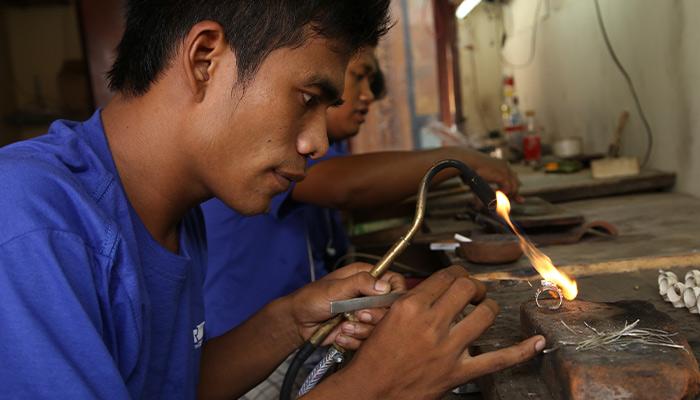
Indonesia is entering an important period in its economic development. With a large working-age population, a rich tradition of craftsmanship, and growing access to digital technology, the country has an opportunity to strengthen its position in international manufacturing and creative industries.
One sector that could benefit from this transformation is the handicraft and jewelry industry.
From traditional woodcarving and textiles to handmade sterling silver jewelry, Indonesian artisans have developed specialized skills over generations. Today, these traditional capabilities are increasingly being combined with modern design, digital tools, and international business practices.
However, a large working-age population alone does not guarantee economic success.
To turn Indonesia’s demographic advantage into sustainable growth, businesses must invest in skills, productivity, technology, and opportunities for younger generations.
For Bali’s jewelry manufacturing industry, this transition presents both promising opportunities and significant challenges.
What Is Indonesia’s Demographic Bonus?
A demographic bonus, also known as a demographic dividend, refers to the potential economic benefits that can arise when a relatively large proportion of a country’s population is of working age compared with the dependent population.
The working-age population is commonly defined as people between 15 and 64 years old.
According to Indonesian government economic information published in 2026, approximately 194.9 million Indonesians, or 68.2% of the population, were in this age group.
This demographic structure provides a potentially favorable foundation for economic development.
However, the actual economic dividend depends on several conditions, including employment opportunities, education, health, investment, and labor productivity.
A large workforce creates potential. Developing that workforce into a skilled and productive one is what determines the results.
Why the Demographic Bonus Matters to the Jewelry Industry
Jewelry manufacturing requires a combination of technical knowledge, creativity, manual skills, and production management.
Unlike industries that rely primarily on automated processes, many jewelry-making activities still depend on experienced workers.
These include:
- Jewelry design and product development.
- Wax carving and model making.
- Lost-wax casting.
- Metal fabrication and soldering.
- Stone setting.
- Filing, polishing, and finishing.
- Quality control and final inspection.
Indonesia’s demographic structure could help jewelry manufacturers develop the next generation of skilled workers.
But new workers do not automatically become experienced artisans.
Jewelry manufacturing requires training, supervision, patience, and practical experience.
The industry’s long-term competitiveness will depend on how effectively businesses transfer traditional skills while introducing modern production methods.
1. Preserving Traditional Craftsmanship Through Younger Generations
Indonesia has a diverse heritage of traditional craftsmanship.
In Bali, jewelry making is particularly associated with communities such as Celuk and surrounding areas in Gianyar, where silversmithing knowledge has been passed between generations.
Traditional Balinese jewelry is known for decorative techniques, detailed metalwork, and distinctive ornamental patterns.
These capabilities remain valuable in a global jewelry market where many products are mass-produced.
However, preserving craftsmanship requires more than celebrating cultural heritage.
Experienced artisans need opportunities to teach younger workers.
Apprenticeships, practical workshops, and structured training can help ensure that specialized knowledge is not lost.
For example, a young jewelry worker may begin by learning filing, soldering, and polishing before progressing to more complex fabrication or stone setting.
This gradual development builds technical confidence and an understanding of product quality.
For jewelry manufacturers, investing in younger artisans is therefore both a cultural responsibility and a long-term business strategy.
2. Combining Traditional Skills with Modern Jewelry Technology
One of the most promising opportunities for Indonesia’s jewelry industry is the combination of traditional craftsmanship and modern technology.
Today, jewelry manufacturers can use computer-aided design (CAD), 3D printing, digital communication, and improved production equipment alongside conventional jewelry-making techniques.
CAD software allows designers to develop precise three-dimensional models.
3D printing can help produce prototypes or casting patterns, depending on the technology and materials used.
These tools can improve communication between designers and manufacturers, especially when customers are located overseas.
However, technology does not eliminate the need for skilled artisans.
A digital model still requires an understanding of metal thickness, casting limitations, stone-setting requirements, assembly, and finishing.
The strongest approach often combines digital precision with practical manufacturing experience.
For younger workers, learning both traditional jewelry techniques and digital tools can create valuable career opportunities.
For established manufacturers, it can improve design development and production consistency.
3. Improving Productivity Instead of Competing Only on Low Labor Costs
Indonesia is sometimes described as an attractive manufacturing destination because of competitive labor costs.
However, labor cost alone is not a sustainable competitive advantage.
Jewelry brands also consider product quality, communication, reliability, delivery schedules, and the manufacturer’s ability to follow specifications.
A lower manufacturing price offers limited value if products require extensive rework or fail to meet customer expectations.
A more sustainable strategy is to improve productivity and manufacturing capability.
For jewelry workshops, this may involve:
- Better production planning.
- Standardized quality-control procedures.
- More efficient material handling.
- Improved training for new workers.
- Appropriate use of casting and fabrication methods.
- Reduced production defects and unnecessary rework.
- Clear communication between design and production teams.
Productivity should not be measured only by the number of pieces completed.
Consistency, workmanship, material efficiency, and customer satisfaction are equally important.
The demographic bonus becomes more valuable when businesses create skilled employment rather than relying primarily on inexpensive labor.
4. Expanding Opportunities for Indonesian Jewelry Exports
Indonesia’s handicraft and jewelry manufacturers have opportunities to work with international customers, including jewelry designers, independent brands, retailers, and wholesalers.
Digital communication makes it easier for overseas customers to discuss designs, request quotations, review samples, and coordinate production without visiting the workshop for every project.
For smaller jewelry manufacturers, this creates opportunities to develop long-term relationships with international clients.
However, export manufacturing also requires business capabilities beyond jewelry-making skills.
Manufacturers need to understand product specifications, commercial documentation, shipping requirements, and the applicable rules in destination markets.
For example, international buyers may request information about metal composition, plating specifications, restricted substances, or product safety.
Requirements vary by country and product category.
The ability to provide clear documentation and communicate accurately can be just as important as craftsmanship.
A younger generation familiar with digital tools, international communication, and modern business systems may help strengthen these capabilities.
5. Digital Skills and E-Commerce Create New Business Opportunities
Digitalization is changing how Indonesian artisans and jewelry manufacturers reach customers.
Previously, many small workshops depended heavily on local buyers, intermediaries, tourism, or established export relationships.
Today, businesses can introduce their products and services through websites, online catalogs, social media, and international marketplaces.
Digital tools can also support internal operations.
Examples include inventory management, production tracking, customer relationship management, and digital quotation systems.
For jewelry manufacturers, these improvements can reduce administrative work and make production information easier to manage.
Younger workers may be especially interested in digital design, product photography, video creation, e-commerce, and online customer communication.
However, digital skills should complement manufacturing knowledge.
A successful online jewelry business still depends on accurate product descriptions, dependable quality, transparent pricing, and reliable delivery.
Technology makes products easier to discover, but customer trust determines whether relationships last.
6. Sustainability and Responsible Jewelry Manufacturing
Environmental and social responsibility are important considerations for many international jewelry brands.
Customers may ask about recycled precious metals, material sourcing, workplace conditions, and production waste.
For Indonesian jewelry manufacturers, responding to these expectations requires practical improvements and accurate documentation.
Possible initiatives include:
Material efficiency
Improving production methods to reduce avoidable metal loss and recover suitable precious-metal scrap.
Recycled materials
Using recycled precious metals when available and when the material meets the required specifications.
Responsible workplace practices
Providing appropriate safety measures, training, and working conditions.
Product durability
Developing jewelry with suitable construction, reliable assembly, and appropriate finishing.
Transparent communication
Avoiding unsupported claims about sustainability, recycled content, or ethical sourcing.
Responsible manufacturing should be treated as an ongoing process rather than simply a marketing statement.
For younger workers entering the industry, awareness of these practices can help establish stronger long-term standards.
7. The Challenges Facing Indonesia’s Jewelry Workforce
Despite its opportunities, Indonesia’s demographic bonus also creates important challenges.
The Skills Gap
A large population of working-age people does not necessarily mean that qualified jewelry workers are readily available.
Specialized skills such as stone setting, precision soldering, and advanced finishing take time to develop.
Generational Changes
Younger Indonesians have more career choices than previous generations.
Some may prefer technology, hospitality, services, or other industries rather than traditional workshop employment.
Jewelry businesses need to make craftsmanship an attractive career path by offering opportunities to learn, develop, and progress.
Global Competition
Indonesia competes with jewelry manufacturers in other countries that may have larger production capacity, advanced machinery, or established international supply chains.
Competing effectively requires differentiation through craftsmanship, flexibility, quality, service, or distinctive design.
Investment in Equipment and Training
Small and medium-sized workshops may face financial limitations when purchasing equipment or developing training programs.
Investment decisions must balance production requirements with realistic business demand.
Maintaining Consistent Quality
As businesses grow or introduce new workers, maintaining consistent quality can become more difficult.
Clear specifications, sample approval, supervision, and quality-control systems are essential.
These challenges show why demographic potential must be supported by deliberate business development.
8. Bali’s Unique Position in Jewelry Manufacturing
Bali has a distinctive position within Indonesia’s jewelry industry.
Its established silversmithing traditions, creative environment, and international connections provide a foundation for custom jewelry manufacturing.
The island is also known internationally for its artistic culture, making it an attractive location for designers seeking products with a strong craftsmanship identity.
However, Bali’s jewelry industry should not depend entirely on traditional designs or its cultural reputation.
International brands often require contemporary products, precise dimensions, consistent finishing, and repeatable manufacturing quality.
The ability to combine Balinese craftsmanship with modern design requirements is therefore especially valuable.
For example, traditional decorative techniques may be adapted to contemporary rings, earrings, pendants, or bracelets.
At the same time, manufacturers may produce minimalist or modern jewelry that does not use traditional Balinese motifs.
This flexibility allows Bali-based workshops to serve different customer markets while preserving their technical heritage.
9. The Role of Small and Medium-Sized Jewelry Manufacturers
Small and medium-sized enterprises play an important role in Indonesia’s creative economy.
In jewelry manufacturing, smaller workshops can offer advantages such as direct communication, flexibility, and the ability to work on specialized designs.
For independent jewelry brands, these characteristics can be useful during product development.
However, smaller workshops also face limitations in production capacity, equipment investment, and workforce development.
Rather than attempting to compete directly with large-scale factories on volume alone, smaller manufacturers can focus on areas where their experience adds value.
These may include custom manufacturing, detailed finishing, specialized craftsmanship, and collaborative product development.
Training employees across several production skills can also improve flexibility, although complex tasks should still be handled by suitably experienced workers.
The demographic bonus provides an opportunity to recruit and develop new talent, but long-term results depend on creating stable and productive businesses.
10. What International Jewelry Brands Should Look for in an Indonesian Manufacturer
For international buyers, Indonesia’s demographic advantage is an interesting economic factor, but it should not be the main reason to choose a manufacturing partner.
A jewelry brand should evaluate the manufacturer’s actual capabilities.
Important considerations include:
Manufacturing experience
Does the workshop understand the materials, construction methods, and finishing techniques required?
Sampling and development
Can the manufacturer review designs, identify potential production issues, and develop suitable samples?
Quality consistency
Are product specifications and quality expectations clearly communicated?
Production capacity
Can the workshop realistically handle the required order quantities and delivery schedules?
Material transparency
Can the manufacturer explain the metals, gemstones, plating, and other materials being used?
Communication
Does the manufacturer provide clear quotations, updates, and responses to technical questions?
Long-term reliability
Can the manufacturer support repeat orders and future collection development?
These practical factors are more meaningful than general claims about low labor costs or the size of the workforce.
Puri Lautan Mutiara: Balinese Craftsmanship and Modern Jewelry Production
At Puri Lautan Mutiara, we have been involved in jewelry manufacturing in Bali since 1998.
Based in Singapadu, Gianyar, our workshop works with international jewelry designers, brands, retailers, and wholesalers.
Our manufacturing activities include sterling silver jewelry, brass jewelry, selected gold jewelry, casting, hand fabrication, stone setting, and finishing according to the requirements of each project.
We also use design-development methods such as CAD and wax modeling where appropriate.
As a small jewelry manufacturing business, we recognize that experienced craftsmanship and workforce development are important to maintaining quality.
Traditional skills remain valuable, but they must be supported by practical training, appropriate technology, and clear production procedures.
For us, the future of Balinese jewelry manufacturing is not simply about having more workers.
It is about developing better skills, improving consistency, and maintaining reliable relationships with customers.
Learn more about our Custom Jewelry Manufacturing Services.
The Future of Indonesia’s Handicraft and Jewelry Industry
Indonesia’s demographic bonus presents an important opportunity, but its benefits are not automatic.
For the handicraft and jewelry industry, the most promising developments will come from investment in people, technology, and business capability.
Traditional artisans have valuable knowledge to pass on.
Younger generations can contribute new skills in digital design, communication, production management, and international marketing.
Manufacturers can strengthen their competitiveness by combining these capabilities rather than treating traditional craftsmanship and modern technology as separate approaches.
The businesses that invest in quality, skills, and long-term relationships will be better positioned to benefit from Indonesia’s changing demographic structure.
Conclusion: Turning Demographic Potential into Lasting Craftsmanship
Indonesia’s large working-age population offers opportunities for the handicraft and jewelry industry.
However, population size alone does not create skilled artisans, reliable manufacturers, or successful export businesses.
Those outcomes require education, practical experience, investment, and consistent business management.
For Bali, the opportunity is especially meaningful.
By preserving traditional silversmithing knowledge while developing modern manufacturing capabilities, the jewelry industry can create valuable employment opportunities and strengthen its position in international markets.
The future of Indonesian jewelry manufacturing will depend not only on how many people are available to work, but also on what they can create, how well they create it, and how effectively businesses support their development.
Looking for a custom jewelry manufacturing partner in Bali?
Contact Puri Lautan Mutiara to discuss your jewelry designs, sampling requirements, and production plans.
Puri Lautan Mutiara — Custom Jewelry Manufacturing in Bali Since 1998.
References and Further Reading
- Statistics Indonesia (BPS) — Population and labor force statistics.
- Coordinating Ministry for Economic Affairs of Indonesia — Economic information and demographic dividend analysis.
- Ministry of National Development Planning (Bappenas) — National development and workforce planning.
- Bappenas Working Papers: Indonesia Employment Outlook 2026–2029.