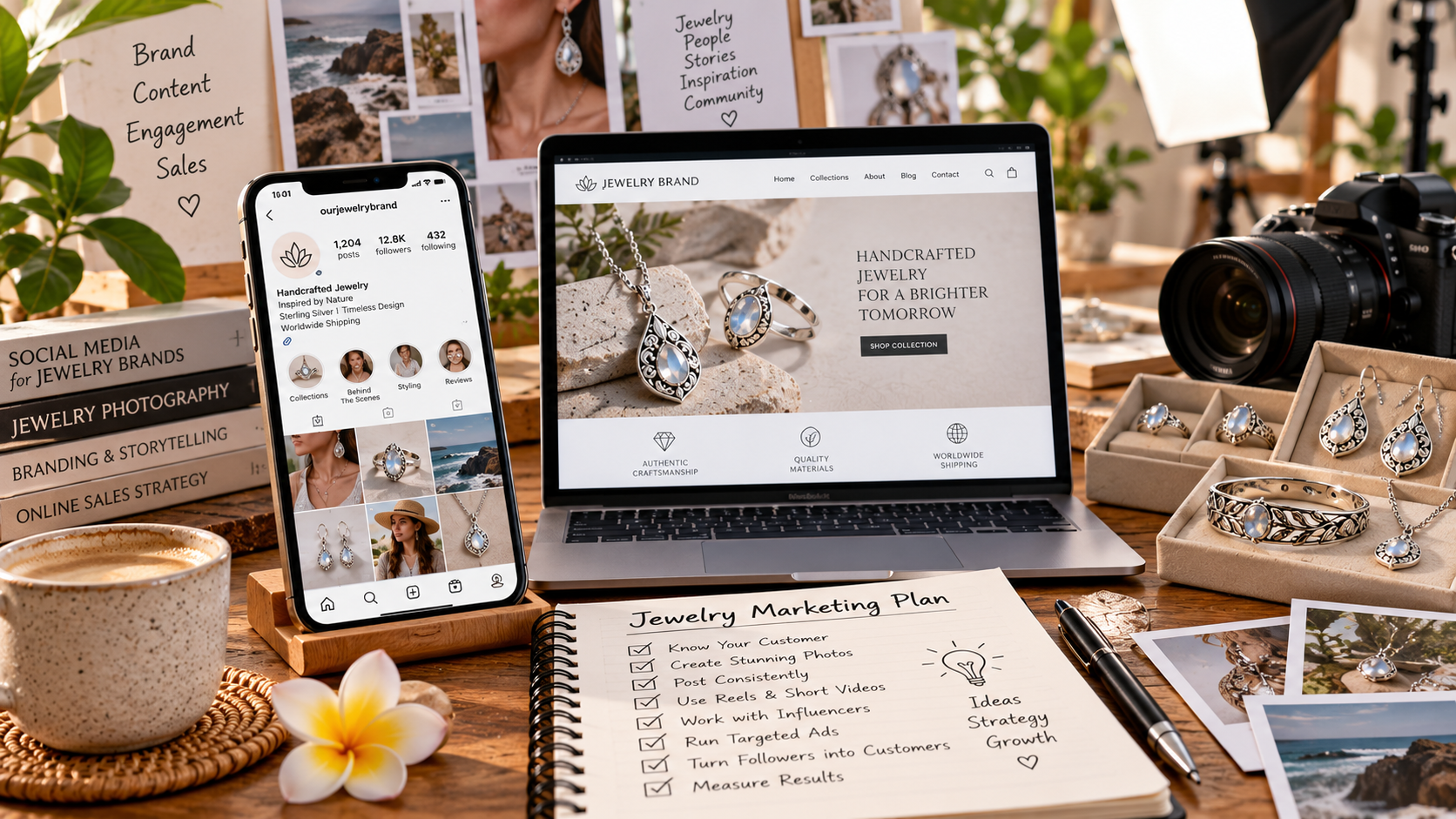
Creating a beautiful jewelry collection is only the beginning of building a successful jewelry business. The next challenge is getting your products in front of the right customers and giving them a reason to buy.
Social media has made it possible for independent jewelry designers and small brands to reach potential customers without relying entirely on traditional retail stores or expensive advertising campaigns.
However, simply posting attractive jewelry photographs is not enough.
Successful jewelry marketing requires a recognizable brand identity, engaging content, a clear understanding of your customers, and a consistent strategy for turning interest into sales.
Whether you are launching your first jewelry collection or growing an established brand, these 12 practical strategies can help you market your jewelry more effectively.
1. Define Your Target Customer Before Choosing a Platform
One of the most common jewelry marketing mistakes is trying to appeal to everyone.
A brand selling minimalist sterling silver jewelry may attract a different audience from one specializing in bold statement pieces, personalized gifts, or luxury gemstone jewelry.
Before investing time and money in social media, identify your ideal customer.
Consider their age range, lifestyle, fashion preferences, shopping habits, and typical jewelry budget.
Think about why they purchase jewelry. Are they buying everyday accessories, meaningful gifts, engagement jewelry, or distinctive designs that express their personality?
These answers should influence your product photography, messaging, pricing, and choice of marketing platforms.
Marketing tip: It is usually more effective to reach a smaller audience that genuinely appreciates your jewelry than a large audience with little interest in purchasing it.
2. Build a Recognizable Jewelry Brand Identity
Jewelry is a highly visual product, but branding goes beyond having an attractive logo.
Your brand identity includes your design style, product quality, photography, packaging, messaging, and the overall experience customers associate with your business.
A strong identity helps customers recognize your products even before they see your brand name.
For example, a jewelry brand inspired by nature might consistently use organic shapes, earthy colors, botanical photography, and storytelling about its design inspiration.
A contemporary minimalist brand may prefer simple backgrounds, clean typography, and understated product styling.
Whichever direction you choose, consistency matters.
Use a recognizable visual style across your website, social media profiles, packaging, and advertising materials.
3. Choose the Right Social Media Platforms
Not every platform will deliver the same results for every jewelry business.
Instead of trying to manage every social network, begin with the platforms that best match your audience and available resources.
Instagram is particularly suitable for visual storytelling, product photography, short videos, and introducing new collections.
Use Reels to demonstrate how jewelry looks when worn, carousels to highlight product details, and Stories to share updates or answer customer questions.
Pinterest can be useful for jewelry discovery, gift inspiration, wedding styling, and fashion-related searches.
Unlike posts that quickly disappear from a social media feed, useful Pins may continue attracting interest over time.
Link product images to relevant pages on your website.
TikTok
TikTok offers opportunities to share short, engaging videos, including styling ideas, design processes, product demonstrations, and behind-the-scenes content.
Authentic videos can be effective, especially when they communicate a clear idea quickly.
Facebook can still be useful for certain customer groups, local communities, customer service, and advertising campaigns.
It may also support brands whose audiences prefer Facebook over newer platforms.
YouTube
YouTube is worth considering for longer educational content, jewelry care guides, collection stories, and detailed product demonstrations.
Our recommendation: Start with one or two platforms, establish a consistent publishing routine, and expand only when you have the resources to maintain quality.
4. Invest in High-Quality Jewelry Photography
Jewelry photography is one of the most important elements of online marketing.
Customers cannot physically examine your jewelry before purchasing it, so photographs must communicate its appearance, proportions, craftsmanship, and finishing.
For an effective product presentation, consider using several types of images.
Clean product photographs
Show the jewelry clearly against a neutral background, including front, side, and back views where appropriate.
Lifestyle photographs
Show the jewelry being worn to help customers understand its size and appearance.
Detail photographs
Highlight textures, gemstone settings, clasps, engraving, and other features that distinguish the design.
Collection photographs
Present related pieces together to communicate the overall style of the collection.
Avoid excessive editing that changes the apparent gemstone color, metal finish, or product proportions.
Accurate photography helps establish realistic expectations and can reduce customer disappointment.
5. Use Short Videos to Show What Photographs Cannot
Videos allow customers to see how jewelry moves, reflects light, and looks from different angles.
A short video may communicate details that are difficult to capture in a single photograph.
Useful jewelry video ideas include:
- A close-up of a ring rotating in natural light.
- A model wearing earrings to demonstrate movement.
- Several ways to style the same necklace.
- A comparison between polished and oxidized finishes.
- The process of transforming a jewelry sketch into a finished piece.
- Packaging an order for shipment.
Videos do not always require expensive production equipment.
A smartphone, stable camera position, suitable lighting, and clean background can be sufficient for many types of content.
The most important consideration is whether the video helps the viewer understand or appreciate the jewelry.
6. Tell the Story Behind Your Jewelry
Customers may be attracted by appearance, but storytelling can help them develop a stronger connection with a brand.
Explain what inspired your designs.
Perhaps a collection was influenced by the ocean, traditional craftsmanship, architecture, travel, or personal experiences.
You can also discuss how materials are selected, how a particular texture is created, or why a design has a special meaning.
For handcrafted jewelry, behind-the-scenes content can be especially interesting.
Showing genuine design development, wax carving, casting, stone setting, or polishing helps customers understand the work involved.
However, make sure your storytelling accurately represents the product.
For example, if a piece is cast and then finished by hand, describe that process rather than suggesting that every part was individually fabricated by hand.
Authenticity is more valuable than exaggerated marketing claims.
7. Create a Consistent Content Strategy
Posting only when you have a new product to sell can make social media marketing inconsistent.
Instead, develop a content plan that combines promotional, educational, and engaging material.
A useful approach is to rotate between several content themes.
Product content: New arrivals, bestsellers, styling photographs, and collection launches.
Educational content: Jewelry care, material differences, gemstone information, and sizing advice.
Behind-the-scenes content: Design sketches, sample development, manufacturing, and packaging.
Customer content: Verified reviews, customer photographs shared with permission, and styling inspiration.
Brand storytelling: Design inspiration, company values, craftsmanship, and the people involved in creating the products.
This variety gives people reasons to follow your brand even when they are not ready to buy immediately.
Example: A Simple Weekly Jewelry Content Plan
| Day | Content idea | Purpose |
|---|---|---|
| Monday | New product or collection photograph | Product awareness |
| Tuesday | Short jewelry styling video | Engagement |
| Wednesday | Behind-the-scenes manufacturing content | Build trust |
| Thursday | Jewelry care or material education | Provide value |
| Friday | Customer review or product demonstration | Encourage purchases |
This is only an example. The right posting frequency depends on your audience, available content, and performance data.
Consistency and quality are generally more useful than publishing large amounts of repetitive content.
8. Use Hashtags, Captions, and Search-Friendly Descriptions
Hashtags can help categorize social media content, but they should not be treated as the main strategy for attracting customers.
Use relevant terms that accurately describe your jewelry and audience.
For example, a sterling silver jewelry brand might use:
#SterlingSilverJewelry #SilverEarrings #HandcraftedJewelry #JewelryDesign
A brand selling personalized jewelry may use different terms focused on custom gifts, engraved jewelry, or birthstone designs.
Avoid relying entirely on extremely broad hashtags such as #fashion or #jewelry.
Captions are equally important.
Describe the product naturally, including relevant details such as material, design inspiration, dimensions, and styling possibilities.
A caption that provides useful information is more valuable than one containing only a long collection of hashtags.
Also use descriptive product names and appropriate alternative text for images where supported.
9. Work with Influencers and Content Creators Carefully
Influencer marketing can introduce your jewelry to audiences that may not already know your brand.
However, the number of followers should not be your only selection criterion.
A smaller creator with an engaged audience interested in jewelry may provide better results than a larger account with unrelated followers.
Before collaborating, review the creator’s content quality, audience relevance, engagement, and previous brand partnerships.
Possible collaborations include product reviews, styling videos, collection launches, and affiliate arrangements.
Agree on the deliverables, content usage rights, compensation, and disclosure requirements before beginning.
Paid or gifted partnerships should be disclosed according to applicable advertising rules.
For smaller jewelry brands, testing a few carefully selected collaborations may be more practical than committing a large budget to one campaign.
10. Turn Social Media Interest into Website Sales
A social media account can attract attention, but customers still need a clear path to purchase.
Make it easy for visitors to find your products, understand their specifications, and complete an order.
Your website should ideally provide:
- Clear product descriptions and photographs.
- Accurate material information.
- Product dimensions and sizing guidance.
- Transparent pricing and shipping information.
- Jewelry care instructions.
- Return and exchange policies.
- Accessible customer support.
Link social media content directly to relevant product pages whenever possible.
For example, a post featuring a particular ring should lead to that ring rather than requiring the customer to search through your entire website.
A simple and trustworthy purchasing experience can make a significant difference.
11. Use Paid Advertising with a Clear Objective
Paid social media advertising can help jewelry brands reach new audiences, but advertising should begin with a specific objective.
Are you trying to introduce a new brand, generate website visits, collect leads, or increase purchases?
Different objectives require different campaign structures and measurements.
For an online jewelry store, product-focused advertising may be useful when the website is ready to accept orders and conversion tracking is properly configured.
Begin with a manageable test budget.
Compare different product photographs, videos, audiences, and messages.
Avoid judging success based only on likes or impressions.
Instead, evaluate how advertising contributes to meaningful business results.
If a campaign generates substantial traffic but very few purchases, the problem may involve product pricing, website usability, customer trust, or the relevance of the audience.
Increasing the advertising budget will not necessarily solve those issues.
12. Measure Results and Improve Your Strategy
Effective jewelry marketing requires ongoing evaluation.
Social media platforms provide various performance metrics, but not every metric has equal business value.
A jewelry brand should consider both audience engagement and commercial results.
Useful measurements include:
Reach and engagement: How many people see and interact with your content?
Website traffic: How many visitors arrive from social media?
Conversion rate: What proportion of visitors complete a desired action?
Customer acquisition cost: How much do you spend to acquire a new customer?
Average order value: How much does a customer typically spend per order?
Repeat purchases: How often do customers return?
You do not need a complicated reporting system when starting out.
A simple monthly review can help identify which products, content formats, and marketing activities generate the strongest results.
Over time, use these insights to improve your content and allocate your marketing budget more effectively.
Common Jewelry Marketing Mistakes to Avoid
Even attractive jewelry collections can struggle when marketing decisions are poorly planned.
Some common mistakes include relying entirely on discounts, purchasing artificial followers, copying competitors’ content, using misleading product photographs, and spending heavily on advertising before the website is ready.
Another mistake is promoting too many unrelated products without a recognizable collection identity.
Customers should be able to understand what your brand represents and why your jewelry is different.
Focus on building trust and presenting your products accurately rather than chasing short-term attention.
Why Product Quality Matters as Much as Marketing
Marketing can introduce customers to a jewelry brand, but product quality strongly influences their experience after purchasing.
If a ring arrives with an incorrect size, a clasp fails, or a plated finish does not meet the advertised specification, attractive social media content cannot compensate for the disappointment.
For jewelry brands developing their own collections, manufacturing quality should therefore be considered part of the broader brand strategy.
Material selection, sample approval, product specifications, finishing consistency, and quality control all influence customer satisfaction.
A dependable manufacturing partner can help a jewelry brand develop products that are practical to produce and consistent with its intended quality standards.
Custom Jewelry Manufacturing for Growing Brands
At Puri Lautan Mutiara, we work with international jewelry designers, retailers, and brands developing custom jewelry collections.
Based in Singapadu, Gianyar, Bali, our company has been involved in jewelry manufacturing since 1998.
Our services include custom jewelry development, sampling, sterling silver manufacturing, selected alternative metals, gemstone setting, and finishing according to agreed specifications.
Whether you are preparing your first collection or expanding an established jewelry brand, we can review your designs and discuss suitable manufacturing approaches.
Learn more about our Custom Jewelry Manufacturing Services and Jewelry Design and Development Process.
Final Thoughts: Successful Jewelry Marketing Builds Trust
Marketing jewelry online requires more than beautiful photographs and frequent social media posts.
Successful brands understand their customers, communicate a clear identity, create useful content, and make purchasing straightforward.
They also recognize that long-term growth depends on delivering products that meet customer expectations.
Start with a focused strategy, test different approaches, and use performance data to guide your decisions.
Above all, build a brand that customers can recognize, trust, and confidently recommend.
Planning to develop your own jewelry collection?
Contact Puri Lautan Mutiara to discuss your designs, materials, sampling, and manufacturing requirements.
Puri Lautan Mutiara — Custom Jewelry Manufacturing in Bali Since 1998.