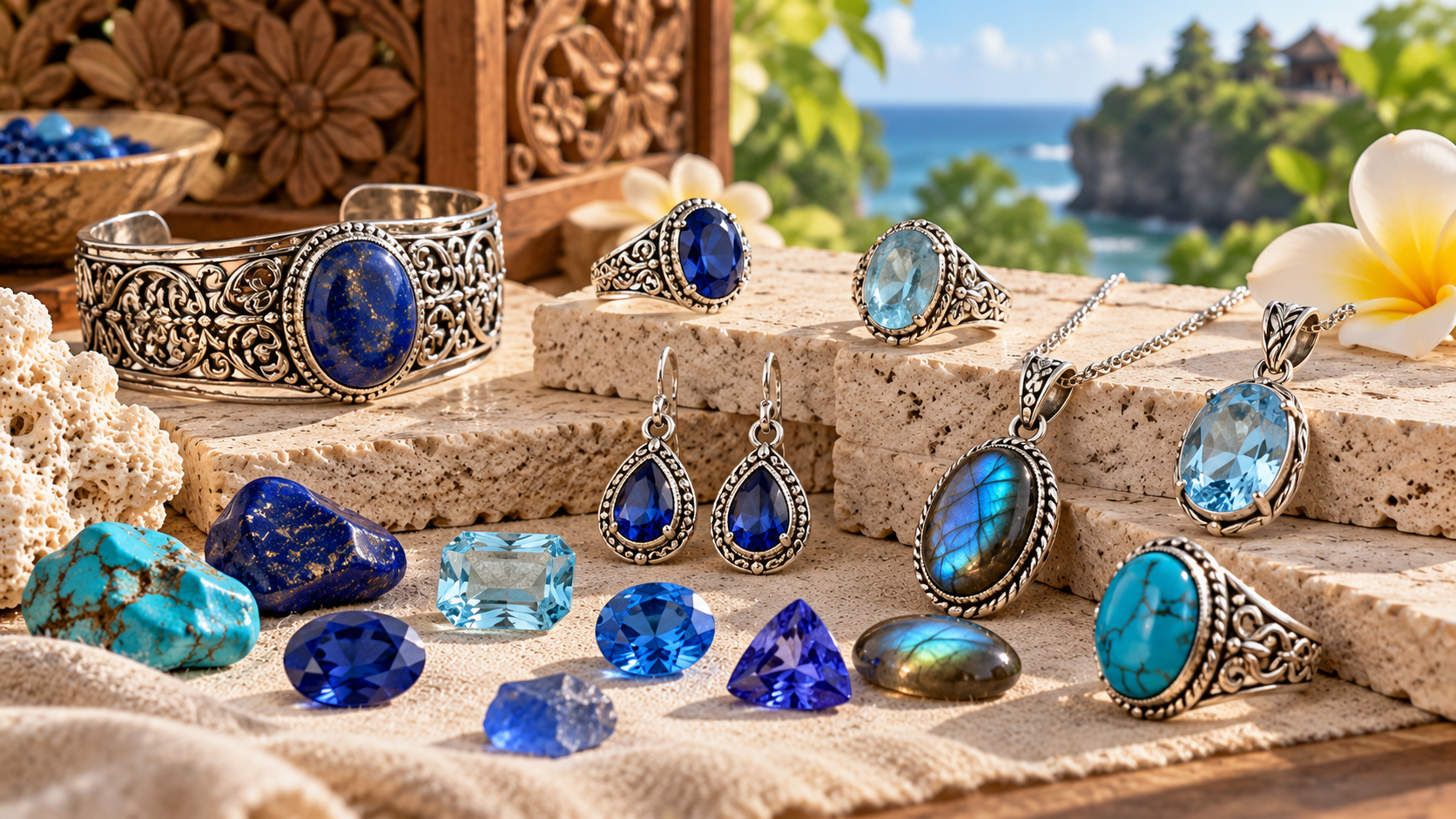
Blue gemstones have fascinated people for centuries. Their colors range from pale sky blue and soft turquoise to deep royal blue and midnight navy.
Throughout history, cultures have associated blue stones with wisdom, tranquility, protection, and loyalty. Today, jewelry designers appreciate them for their beauty, variety, and versatility.
From precious sapphires to affordable blue chalcedony, these gemstones offer possibilities for rings, earrings, necklaces, bracelets, and custom jewelry collections.
However, not all blue gemstones share the same durability, price, or care requirements.
This guide explores 15 beautiful blue gemstones, their properties, traditional symbolism, and practical uses in modern jewelry.
1. Blue Sapphire: A Timeless Precious Gemstone
Blue sapphire belongs to the corundum mineral family. Traces of iron and titanium contribute to its characteristic blue color.
With a hardness of 9 on the Mohs scale, sapphire offers excellent resistance to scratching.
Its color ranges from pale blue to rich royal blue and deep navy.
Historically, people associated sapphire with royalty, wisdom, and loyalty.
Jewelry applications: Engagement rings, fine jewelry, pendants, and earrings.
Mohs hardness: 9
Important consideration: Many natural sapphires undergo heat treatment to improve their appearance. Buyers should request appropriate treatment disclosure.
2. Aquamarine: The Color of Clear Ocean Water
Aquamarine belongs to the beryl mineral family, which also includes emerald.
Its delicate blue and blue-green colors make it popular for elegant, contemporary jewelry.
The name comes from Latin words meaning seawater.
Historically, sailors associated aquamarine with protection during sea voyages.
Jewelry applications: Rings, pendants, earrings, and minimalist jewelry.
Mohs hardness: 7.5–8
Design suggestion: Aquamarine pairs beautifully with polished sterling silver and white gold.
3. Blue Topaz: Brilliant and Accessible
Blue topaz offers attractive transparency and brilliance at generally accessible prices.
The jewelry market commonly recognizes three commercial color categories: Sky Blue, Swiss Blue, and London Blue.
Most strongly colored blue topaz available commercially has undergone irradiation and heat treatment to develop or enhance its blue color.
Jewelry applications: Statement rings, earrings, necklaces, and contemporary silver jewelry.
Mohs hardness: 8
Important consideration: Despite its hardness, topaz has perfect cleavage and can fracture from a sharp impact.
4. Lapis Lazuli: Ancient Beauty with Golden Flecks
Lapis lazuli is a rock composed mainly of lazurite, often accompanied by calcite and pyrite.
Its rich blue color and occasional golden pyrite inclusions create a distinctive appearance.
Ancient civilizations used lapis lazuli for ornaments, carvings, and pigments.
Jewelry applications: Cabochon rings, pendants, beads, and traditional decorative jewelry.
Approximate Mohs hardness: 5–6
Design suggestion: Oxidized sterling silver complements the deep blue color and golden inclusions.
5. Turquoise: A Classic Blue-Green Gemstone
Turquoise is an opaque mineral known for its blue and greenish-blue colors.
Its appearance may include natural matrix patterns formed by surrounding rock.
Turquoise has played an important role in jewelry traditions across several cultures, including ancient Egyptian, Persian, and Native American communities.
Jewelry applications: Rings, cuffs, pendants, earrings, and beaded jewelry.
Mohs hardness: 5–6
Important consideration: Turquoise is relatively porous. Some material undergoes stabilization, dyeing, or other treatments.
6. Blue Spinel: An Elegant Alternative to Sapphire
Spinel is a distinct mineral species, although historical jewelers sometimes confused it with ruby and sapphire.
Natural blue spinel ranges from grayish blue to vivid cobalt-like shades.
High-quality blue spinel can be rare and valuable.
Jewelry applications: Fine jewelry, rings, earrings, and pendants.
Mohs hardness: 8
Design suggestion: Faceted blue spinel works well in elegant sterling silver or gold settings.
7. Tanzanite: Violet-Blue Elegance
Tanzanite is the blue-to-violet variety of zoisite.
Commercially important deposits occur in northern Tanzania, near Mount Kilimanjaro.
Tanzanite became internationally known during the twentieth century.
Its strong pleochroism means that the gemstone can display different colors when viewed from different directions.
Jewelry applications: Pendants, earrings, dress rings, and fine jewelry.
Mohs hardness: 6–7
Important consideration: Tanzanite requires care because of its cleavage and sensitivity to sharp impacts.
8. Labradorite: A Gemstone with Blue Flashes
Labradorite belongs to the feldspar mineral group.
It is famous for labradorescence, an optical effect that creates flashes of blue, green, gold, or other colors.
Unlike transparent gemstones, labradorite often looks most attractive when cut as a cabochon.
Jewelry applications: Pendants, statement rings, earrings, and artistic silver jewelry.
Mohs hardness: 6–6.5
Design suggestion: Labradorite complements oxidized silver and handcrafted Balinese patterns.
9. Blue Chalcedony: Soft and Subtle Beauty
Blue chalcedony is a microcrystalline variety of quartz.
Its soft, translucent appearance creates an understated elegance.
Colors range from pale grayish blue to more saturated blue tones.
Jewelry applications: Cabochon rings, earrings, pendants, and minimalist jewelry.
Mohs hardness: Approximately 6.5–7
Design suggestion: Blue chalcedony is especially attractive in smooth bezel settings.
10. Iolite: A Gemstone with Changing Blue Tones
Iolite is the gem variety of the mineral cordierite.
It displays strong pleochroism, meaning its color changes depending on the viewing direction.
Its shades range from violet-blue to grayish blue.
Jewelry applications: Faceted earrings, pendants, and dress rings.
Mohs hardness: 7–7.5
Important consideration: Cutters must orient iolite carefully to display its most attractive color.
11. Blue Zircon: Natural Brilliance
Zircon is a natural gemstone with strong brilliance and fire.
Blue zircon can display vivid blue colors, often produced or enhanced through heat treatment.
Zircon should not be confused with cubic zirconia, which is a different material.
Jewelry applications: Earrings, pendants, and decorative rings.
Mohs hardness: Approximately 6–7.5, depending on the material.
Important consideration: Zircon can be brittle, and facet edges may abrade during wear.
12. Larimar: A Tropical Blue Gemstone
Larimar is a blue variety of pectolite found commercially in the Dominican Republic.
Its blue and white patterns often resemble ocean waves or clouds.
These characteristics make it particularly attractive for coastal and tropical jewelry designs.
Jewelry applications: Cabochon pendants, earrings, rings, and artistic silver jewelry.
Mohs hardness: Approximately 4.5–5
Design suggestion: Larimar works beautifully in silver pendants with simple or organic settings.
13. Blue Tourmaline: From Pale Blue to Deep Indicolite
Tourmaline is a mineral group known for its wide variety of colors.
Blue tourmaline is often called indicolite in the gemstone trade.
Its color can range from light blue-green to deep blue.
Jewelry applications: Fine jewelry, rings, pendants, and earrings.
Mohs hardness: 7–7.5
Important consideration: Tourmaline may contain natural inclusions, and some material receives treatments to modify its color.
14. Kyanite: Rich Blue with Distinctive Structure
Kyanite is an aluminum silicate mineral that often displays attractive blue colors.
It has directional hardness, which means its resistance to scratching varies depending on the crystal orientation.
Jewelry applications: Earrings, pendants, and occasional-wear rings.
Mohs hardness: Approximately 4.5–7, depending on direction.
Important consideration: Its cleavage makes protective settings and careful handling important.
15. Blue Apatite: Vibrant Color for Decorative Jewelry
Blue apatite can display bright ocean-blue, teal, and greenish-blue shades.
Its attractive color makes it popular in decorative jewelry, although it is softer than many other gemstones.
Jewelry applications: Pendants, earrings, beads, and occasional-wear jewelry.
Mohs hardness: 5
Design suggestion: Use protective settings and avoid designs that expose the stone to frequent impacts.
Comparing Blue Gemstones for Jewelry
The table below summarizes the main characteristics of these gemstones.
| Gemstone | Mohs Hardness | Typical Appearance |
|---|---|---|
| Blue Sapphire | 9 | Royal to deep blue |
| Aquamarine | 7.5–8 | Pale blue to blue-green |
| Blue Topaz | 8 | Light to intense blue |
| Lapis Lazuli | 5–6 | Deep opaque blue |
| Turquoise | 5–6 | Blue to greenish blue |
| Blue Spinel | 8 | Grayish to vivid blue |
| Tanzanite | 6–7 | Violet-blue |
| Labradorite | 6–6.5 | Dark base with blue flashes |
| Blue Chalcedony | 6.5–7 | Soft translucent blue |
| Iolite | 7–7.5 | Violet-blue to gray-blue |
| Blue Zircon | 6–7.5 | Brilliant blue |
| Larimar | 4.5–5 | Sky blue with white patterns |
| Blue Tourmaline | 7–7.5 | Blue to blue-green |
| Kyanite | 4.5–7 | Deep blue |
| Blue Apatite | 5 | Bright blue to teal |
Mohs hardness measures resistance to scratching, not overall toughness. Cleavage, fractures, treatments, and jewelry construction also affect durability.
Which Blue Gemstone Is Best for Everyday Jewelry?
The best choice depends on the jewelry type and how frequently it will be worn.
For rings that experience regular contact with hard surfaces, sapphire generally provides excellent scratch resistance and practical durability.
Spinel, aquamarine, and some tourmalines can also be suitable choices when designers use appropriate settings.
Softer or more fragile gemstones, such as larimar, apatite, and kyanite, may be better suited to pendants or earrings.
Gemstone durability should always be evaluated beyond Mohs hardness alone.
Blue Gemstones in Sterling Silver Jewelry
Sterling silver offers an attractive setting for blue gemstones.
Its bright, neutral color complements pale aquamarine, vivid blue topaz, and dark lapis lazuli.
Different finishes create different visual effects.
High-polish silver creates a clean, modern appearance.
Oxidized silver emphasizes decorative patterns and complements darker stones.
Matte or satin silver creates a softer, contemporary look.
Balinese silver craftsmanship can add intricate details through traditional textures, granulation, and ornamental metalwork.
For jewelry brands, combining blue gemstones with sterling silver provides opportunities to develop collections across different styles and price points.
Natural, Treated, and Synthetic Blue Gemstones
Gemstone buyers should understand the difference between natural, treated, and laboratory-created materials.
Natural gemstones form through geological processes.
Treated gemstones originate from natural materials but undergo processes intended to improve color, clarity, or appearance.
Synthetic gemstones are laboratory-created materials with essentially the same chemical composition and crystal structure as their natural counterparts.
Imitation gemstones resemble another material but do not share its essential properties.
Treatments and material identity should be disclosed accurately.
For commercial jewelry production, clear material specifications help manufacturers maintain consistent quality and avoid misunderstandings.
How to Choose Blue Gemstones for Custom Jewelry
Jewelry designers should consider several factors before selecting gemstones.
Color and Consistency
Natural gemstones often vary in shade.
For repeat production, buyers should establish acceptable color ranges rather than expecting every stone to look identical.
Dimensions and Shape
Common gemstone shapes include round, oval, pear, cushion, and marquise.
Precise dimensions are important for CAD modeling, casting, and stone setting.
Cutting and Finish
Faceted gemstones emphasize brilliance, while cabochons showcase color, patterns, and optical effects.
Durability
Consider whether the stone will be used in a ring, bracelet, pendant, or earrings.
Availability
Some gemstone varieties are readily available in calibrated sizes, while others require individual sourcing.
Budget
Gemstone prices depend on quality, size, treatments, origin, rarity, and market availability.
A more expensive stone is not necessarily the best choice for every jewelry collection.
Custom Blue Gemstone Jewelry Manufacturing in Bali
Bali has a long tradition of silver jewelry craftsmanship, particularly in the Gianyar region.
At PT Puri Lautan Mutiara (PLM Bali), we have manufactured jewelry since 1998.
Our small workshop works with sterling silver, brass, and gold jewelry for international designers, retailers, and brands.
Our services include:
- Custom jewelry development from sketches and reference images
- CAD design support and 3D printing
- Hand-carved wax models and mold making
- Lost-wax casting
- Gemstone sourcing and setting
- Traditional Balinese decorative metalwork
- Polishing, oxidizing, and plating
- OEM and ODM jewelry production
We can discuss gemstone options based on design specifications, stone availability, and budget.
Our typical minimum order quantity starts at approximately 5–10 pieces per style or size, depending on the project.
For custom gemstone jewelry, we recommend confirming stone dimensions, quality expectations, and sourcing arrangements before production begins.
Frequently Asked Questions About Blue Gemstones
What is the most durable blue gemstone?
Blue sapphire is among the most durable commonly used blue gemstones, with a Mohs hardness of 9 and generally good toughness.
What is an affordable alternative to blue sapphire?
Blue topaz, blue chalcedony, and certain other blue gemstones can offer attractive alternatives, depending on size and quality.
Are all blue gemstones natural?
No. The market includes natural, treated, synthetic, and imitation materials. Buyers should confirm the actual material and relevant treatments.
Which blue gemstones look best in sterling silver?
Aquamarine, blue topaz, lapis lazuli, labradorite, turquoise, and many other blue stones complement sterling silver.
Can blue gemstones be used in custom jewelry production?
Yes. Manufacturers can incorporate blue gemstones into custom designs when suitable sizes, shapes, and quality grades are available.
Conclusion
Blue gemstones offer an extraordinary variety of colors, textures, and design possibilities.
From the timeless elegance of sapphire to the tropical appearance of larimar and the distinctive flashes of labradorite, each gemstone brings something different to jewelry design.
Understanding gemstone hardness, treatments, and care requirements helps buyers choose suitable materials.
For jewelry designers and brands, the combination of blue gemstones and sterling silver offers opportunities to create collections that balance craftsmanship, appearance, and practical quality.
If you are developing a custom gemstone jewelry collection, we welcome your inquiries.
Contact PLM Bali for Custom Jewelry Manufacturing
PT Puri Lautan Mutiara — Bali Jewelry Manufacturer Since 1998.