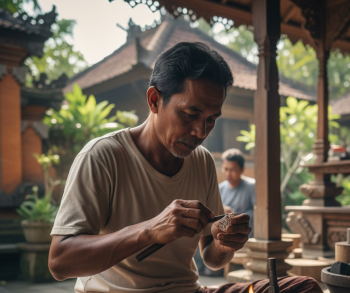
— From Idea to Finished Piece
In the world of custom jewelry manufacturing, every piece has a story. Behind every ring, earring, or pendant lies a series of precise steps, decisions, and craftsmanship that turn a simple idea into a beautiful, wearable artwork. At Puri Lautan Mutiara, we believe transparency is important—especially for new customers who may wonder why custom production takes time and why every stage matters.
Here is a clear breakdown of what really happens behind the scenes.
1. Receiving the Concept — Drawing, Specification, or Sample
Every project begins with the customer’s vision. This usually comes in the form of:
- A hand-drawn sketch
- Technical specification
- Photos or sample pieces
- Reference images from social media or catalogs
Before anything begins, our team studies the design to understand:
- Structural feasibility
- Stone sizes and settings
- Estimated weight
- Complexity of details
- Techniques required (casting, hand work, soldering, etc.)
This stage is important because the level of detail determines the next steps in the production workflow.
2. Quotation and Feasibility — Requires Time and Precision
Once the design is understood, we prepare an accurate quotation.
This process is not instant. It may take a few days, depending on:
- How complex the structure is
- The number of components
- Whether stones need to be sourced
- Whether surface finishing (e.g., matte, hammered, high polish) requires additional steps
- The estimated silver or gold weight
A proper quotation requires calculation, checking past references, and sometimes several internal discussions with our wax carvers, CAD team, and smiths.
Providing a rushed estimate risks miscalculation—and could cause problems later. That’s why we prefer accuracy over speed.
3. CAD Modeling or Hand-Carved Wax
Once the quotation is approved, we move to the design creation phase. Depending on the style, the project will go through one of two routes:
Route A: CAD (Computer-Aided Design)
CAD is used for:
- Geometric pieces
- Precision settings
- Mechanical links
- Modern, symmetrical designs
The CAD process usually takes 2–5 days, depending on revisions.
Once done, a 3D render or screenshot is sent to the customer for approval before printing the wax.
Route B: Direct Hand-Carved Wax
Some jewelry is better created by hand, especially:
- Organic shapes
- Antique or textured surfaces
- Balinese or Jawan-style pieces
- Sculptural or artistic forms
A hand-carved wax model may take 3–7 days depending on detail and size.
Both methods require skilled artisans and careful attention, because this wax model becomes the foundation of the final metal piece.
4. Wax to Metal — Casting Process
After the wax is finalized, it moves to the casting stage:
- Wax trees are assembled.
- Investment plaster is poured.
- Burnout process removes the wax.
- Molten silver or gold is cast into the empty mold.
Casting requires:
- Temperature control
- Clean metal preparation
- Checking shrinkage tolerance
- Avoiding air traps or porosity
The result is a raw metal version of the jewelry, still needing refinement.
5. Cleaning, Filing, and Assembly
The raw casting is not yet beautiful. It undergoes:
- Cutting sprues
- Filing and smoothing
- Reshaping
- Soldering components
- Stone-setting preparation
This stage ensures the piece is structurally strong and ready for detail work.
6. Stone Setting, Engraving, and Detail Craftsmanship
If the design includes stones:
- Seats are cut
- Stones are aligned
- Prongs are tightened
- Surface details are carved
This stage is highly skilled and time-consuming because precision determines both beauty and durability.
7. Polishing and Surface Finishing
The finishing stage transforms the metal into its final appearance. Options include:
- High polish
- Matte
- Satin
- Hammered
- Oxidized
- Sandblast
- Combination finishing
Polishing is done in several steps using different wheels and compounds. Even a simple piece can go through multiple rounds before it shines perfectly.
8. Quality Control and Final Inspection
Before shipping, every piece is checked carefully:
- Dimensions
- Stone security
- Surface scratches
- Symmetry
- Weight accuracy
- Design matching the original brief
Only after passing QC do we prepare the final packaging.
9. Completion — The Moment the Idea Becomes Reality
From an initial drawing to the final polish, a custom jewelry piece may involve 5–10 different artisans, each with their own skill set.
That’s why custom manufacturing is a journey — not a quick process.
Every stage is done with intention, precision, and respect for craftsmanship.
Conclusion
Understanding the process helps customers appreciate the value behind their jewelry. Custom work is never “instant”; it is a collaboration between the customer’s imagination and the artisan’s hands.
At Puri Lautan Mutiara, we are proud to guide you through each stage, ensuring your ideas become timeless creations.