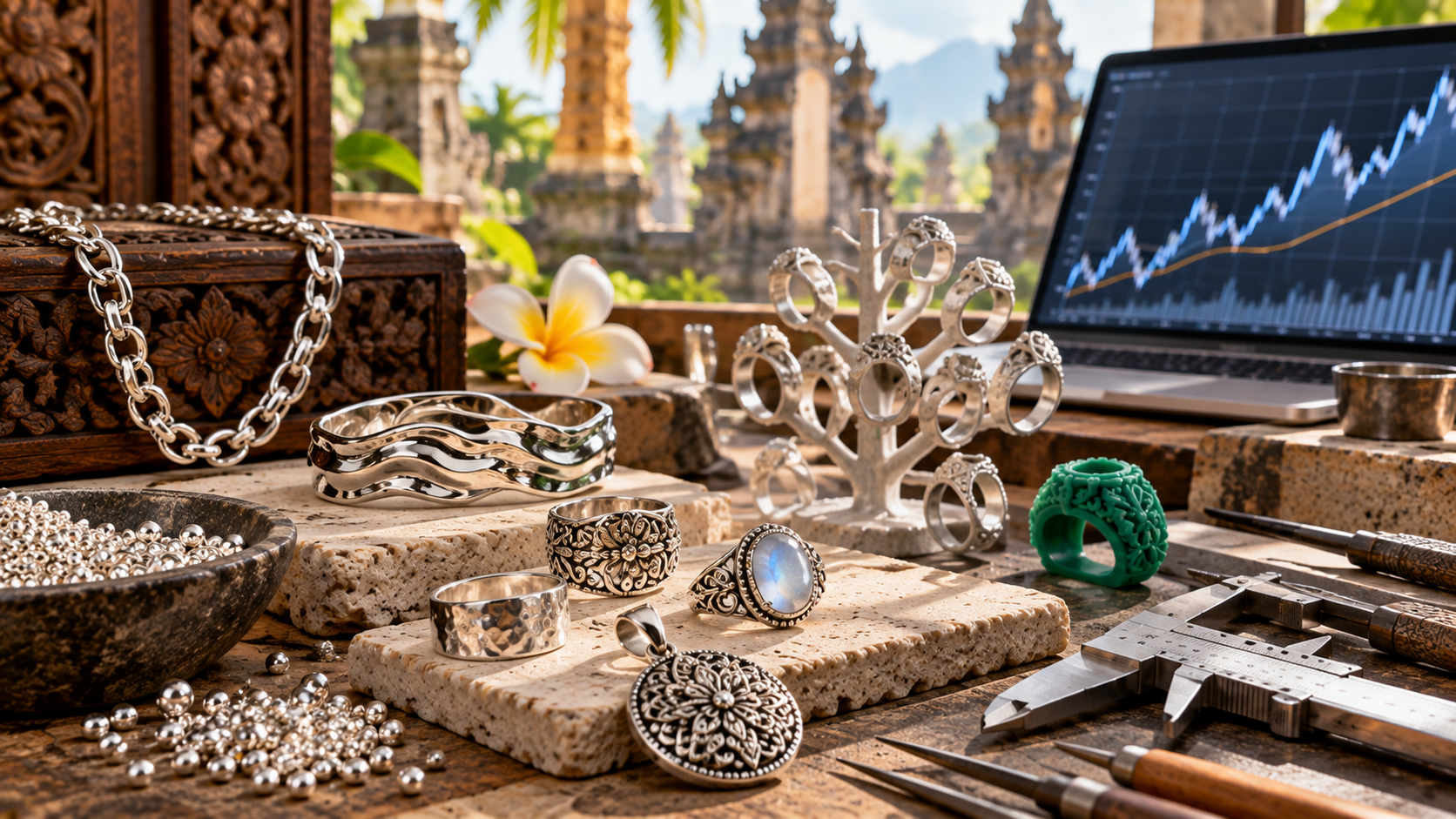
The silver jewelry industry has experienced an unusually volatile year in 2026. After a remarkable price rally, silver prices corrected sharply. Meanwhile, global economic uncertainty continued to affect manufacturers, retailers, and consumers.
For jewelry businesses, these developments created both challenges and opportunities.
Higher material costs made pricing more difficult. However, changing market conditions also encouraged manufacturers to reconsider product weight, production efficiency, and collection planning.
At PT Puri Lautan Mutiara (PLM Bali), we have worked in jewelry manufacturing since 1998. Therefore, we understand how changes in precious-metal prices can affect a small workshop and its international customers.
In this article, we examine the silver jewelry market in 2026, explain recent price movements, and discuss practical strategies for jewelry brands.
Market update: October 2026.
1. What Happened to Silver Prices in 2026?
Silver began 2026 with exceptional price volatility.
According to the London Bullion Market Association (LBMA), the silver price reached a high of US$118.45 per troy ounce on January 29, 2026.
However, prices later declined significantly.
On July 17, the market recorded a low of US$55.29 per ounce. During the third quarter, prices fluctuated between approximately US$55 and US$70.
Consequently, manufacturers experienced a very different market from the one anticipated at the beginning of the year.
The important lesson is that silver prices do not move in one direction.
Although long-term demand and supply conditions matter, short-term prices can change rapidly because of investment activity, monetary policy, and global economic developments.
Source: LBMA Precious Metals Market Report, Q3 2026
2. Why Are Silver Prices So Volatile?
Several factors influence the silver market.
Unlike gold, silver has substantial industrial applications. Therefore, its price reflects both investment demand and industrial activity.
Industrial Demand
Silver is used in electronics, solar technology, electrical equipment, and other industrial applications.
However, high prices can encourage manufacturers to reduce silver consumption.
For example, some solar manufacturers are developing technologies that use less silver or substitute other materials.
As a result, industrial demand may not increase continuously, even when the industries using silver continue to grow.
Investment Demand
Investors sometimes purchase silver during periods of economic uncertainty.
Meanwhile, changes in interest rates and the U.S. dollar can influence precious-metal prices.
Strong investment demand can push prices upward quickly. However, changing expectations may also cause sharp corrections.
Global Supply
Silver production depends on mining and recycling.
Importantly, much of the world’s silver is produced as a by-product of mining other metals.
Therefore, higher silver prices do not always lead to an immediate increase in mine supply.
Geopolitical and Trade Uncertainty
International trade policies, tariffs, and geopolitical developments can influence investor sentiment and physical metal flows.
However, these factors do not affect every jewelry manufacturer in the same way.
Businesses should evaluate their actual sourcing arrangements and export destinations.
3. Is the Global Silver Market Still in Deficit?
According to the Silver Institute’s World Silver Survey 2026, the global silver market is expected to experience its sixth consecutive annual supply deficit.
A market deficit occurs when total demand exceeds newly available supply from mining and recycling.
However, a deficit does not guarantee that prices will rise.
Existing inventories, investment flows, interest rates, and market expectations also influence prices.
Moreover, sustained high prices can reduce demand.
For example, jewelry buyers may purchase fewer pieces, while industrial manufacturers may use less silver.
Consequently, the market can remain in deficit even while silver prices decline.
Source: World Silver Survey 2026 — The Silver Institute
4. How Higher Silver Prices Affect Jewelry Manufacturers
For jewelry manufacturers, silver is not simply a decorative material. It is also an important production cost.
Therefore, price fluctuations directly affect quotations and profit margins.
Higher Raw Material Costs
A heavier jewelry design requires more silver.
For example, a 20-gram bracelet contains substantially more precious metal than a 5-gram pendant.
As silver prices increase, the difference in material cost becomes more significant.
Difficult Quotation Planning
Custom jewelry orders often require several weeks of production.
However, the silver price may change between the initial quotation and material purchasing.
Consequently, manufacturers need clear quotation validity periods and payment arrangements.
Pressure on Small Workshops
Small manufacturers may have limited working capital.
Therefore, purchasing large quantities of silver during volatile markets can create financial pressure.
At the same time, holding too little inventory may expose the workshop to sudden price increases.
Changing Customer Expectations
Some customers continue to request traditional designs and heavier jewelry.
Others prefer lighter pieces to maintain a target retail price.
As a result, manufacturers need to discuss material weight and construction during product development.
5. Understanding the Real Cost of Sterling Silver Jewelry
The silver market price is only one part of the final jewelry cost.
Sterling silver contains 92.5% silver by mass. The remaining 7.5% generally consists of other metals, commonly copper.
However, the finished product price also includes manufacturing expenses.
These may include:
- Silver and alloy materials
- Wax carving or CAD development
- Mold making and casting
- Soldering and assembly
- Gemstone setting
- Polishing and finishing
- Plating and engraving
- Quality control
- Packaging and shipping
Therefore, two jewelry pieces with the same weight may have very different manufacturing prices.
A simple pendant may require relatively little labor. In contrast, a detailed ring with multiple gemstones can involve several production stages.
Example: How Silver Prices Affect Material Cost
Consider a hypothetical 10-gram sterling silver ring.
It contains approximately 9.25 grams of fine silver.
| Silver spot price | Approximate fine silver value |
|---|---|
| US$50 per troy ounce | US$14.87 |
| US$60 per troy ounce | US$17.84 |
| US$80 per troy ounce | US$23.79 |
| US$100 per troy ounce | US$29.74 |
These figures are illustrative calculations, not current supplier quotations.
They exclude alloy costs, manufacturing losses, labor, tooling, finishing, and other expenses.
Nevertheless, the comparison demonstrates why silver price movements can significantly affect jewelry costs.
6. Why Global Silver Jewelry Demand May Decline
High silver prices can reduce consumer demand.
According to the Silver Institute’s February 2026 outlook, global jewelry silver consumption was projected to decline by more than 9% during the year.
This forecast reflects the effect of elevated prices on consumers in several important markets.
However, lower consumption by metal weight does not necessarily mean that every jewelry brand will experience lower sales revenue.
For example, consumers may purchase lighter jewelry or products with greater design value.
Similarly, brands may adjust their collections toward different price points.
Therefore, manufacturers should distinguish between the quantity of silver consumed and the commercial performance of finished jewelry.
Source: The Silver Institute — Global Silver Investment Outlook 2026
7. Jewelry Design Strategies During High Silver Prices
Manufacturers and designers can respond to higher material costs without abandoning sterling silver.
However, changes should preserve product quality and durability.
Develop Lightweight Designs
Careful design can reduce unnecessary metal weight.
For example, a pendant may use an open structure rather than a solid metal surface.
Similarly, earrings can incorporate hollow or fabricated components when suitable.
However, excessively thin metal may create durability problems.
Therefore, weight reduction should always involve technical evaluation.
Focus on Design Value
A product’s retail appeal does not depend entirely on metal weight.
Distinctive shapes, textures, and craftsmanship can add value.
For example, a relatively lightweight pendant may feature intricate hand-finished details.
As a result, brands can create visually interesting jewelry without relying on heavy construction.
Consider Mixed Materials
Sterling silver can be combined with gemstones, pearls, resin, or other appropriate materials.
Moreover, brass with gold plating may be suitable for certain fashion jewelry collections.
However, manufacturers must clearly disclose the actual materials used.
Gold-plated brass should never be represented as solid gold or sterling silver.
Improve Production Efficiency
Better casting layouts, suitable sprue systems, and effective scrap recovery can reduce avoidable material losses.
In addition, consistent product specifications can help prevent costly rework.
These improvements become increasingly valuable when silver prices are volatile.
8. Does Recycled Silver Reduce Manufacturing Costs?
Recycled silver is an important subject in jewelry manufacturing.
However, it is often misunderstood.
Recycled silver is not automatically cheaper than newly refined silver.
Its market value still reflects the silver content, refining requirements, and prevailing metal prices.
Nevertheless, recovering usable silver from production scrap can improve material efficiency.
For example, casting sprues, clean offcuts, and other recoverable materials may be returned to an appropriate refining or reuse process.
However, manufacturers must control alloy composition and contamination.
Moreover, claims about recycled content should be supported by suitable records or verification.
Using recycled silver alone does not establish that an entire product is environmentally sustainable.
9. How Jewelry Brands Can Manage Silver Price Risk
Jewelry brands can take several practical steps to reduce uncertainty.
Request Updated Quotations
Silver prices can change quickly.
Therefore, buyers should confirm quotation validity and the metal price assumptions used.
Approve Designs Before Production
Late design changes can increase labor and material requirements.
As a result, clear technical approvals help reduce unexpected expenses.
Discuss Target Weight
Weight is an important factor in sterling silver jewelry pricing.
For example, a brand can specify a preferred weight range during development.
However, the manufacturer must confirm whether the target is technically practical.
Plan Repeat Orders
Reliable forecasts can help workshops organize materials and production schedules.
Moreover, repeat orders may reduce some development and setup expenses.
Consider Several Price Scenarios
Brands should evaluate how different silver prices affect their product margins.
For instance, a collection may remain profitable at one material price but require retail adjustments at another.
Therefore, scenario planning can support more realistic pricing decisions.
10. What Does the Silver Market Mean for Bali?
Bali has a longstanding tradition of silver jewelry manufacturing.
Celuk, Singapadu, and surrounding areas in Gianyar are associated with skilled metalworking and jewelry production.
However, local workshops are not isolated from international commodity markets.
When silver prices change, Balinese manufacturers face many of the same challenges as producers elsewhere.
These include material purchasing, production costs, and customer pricing expectations.
Nevertheless, Bali offers opportunities in custom and small-batch manufacturing.
Traditional craftsmanship, decorative finishing, and flexible design development can help workshops serve specialized markets.
For example, a jewelry brand may prefer a smaller collection featuring distinctive Balinese textures rather than a large quantity of generic products.
However, craftsmanship alone does not guarantee commercial success.
Quality, communication, realistic pricing, and reliable production remain essential.
11. How PLM Bali Approaches a Changing Market
At PT Puri Lautan Mutiara (PLM Bali), we have worked in jewelry manufacturing since 1998.
Our small workshop produces sterling silver, brass, and gold jewelry for international designers, retailers, and brands.
During periods of silver price volatility, we believe practical communication becomes particularly important.
Therefore, we encourage customers to provide clear specifications and discuss target weights before production.
Our manufacturing capabilities include:
- 925 sterling silver jewelry
- Brass and selected gold jewelry
- CAD design support and 3D printing
- Hand-carved wax models
- Lost-wax casting and mold making
- Soldering and assembly
- Gemstone setting
- Laser engraving
- Polishing and oxidized finishing
- Gold plating and rhodium plating
Our typical minimum order quantity starts at approximately 5–10 pieces per style or size, depending on the design.
Meanwhile, many standard custom orders generally require around 4–6 weeks after the necessary approvals and arrangements are completed.
However, complex projects may require additional development time.
We review each inquiry individually and provide quotations based on the specifications and material costs applicable to the project.
Our objective is not to compete with large factories in every product category. Instead, we focus on manufacturing projects that match our workshop’s capabilities.
12. Silver Jewelry Outlook for the Rest of 2026 and Beyond
The final months of 2026 remain uncertain.
Silver prices may respond to interest-rate decisions, investment flows, industrial demand, and geopolitical developments.
Moreover, higher prices may continue encouraging manufacturers to reduce silver usage.
However, lower prices could also improve the affordability of jewelry and support renewed demand.
Therefore, predicting one specific price direction would be unreliable.
For jewelry manufacturers, a more practical approach involves preparing for several possible market conditions.
This includes monitoring material costs, improving production efficiency, and maintaining clear communication with customers.
Ultimately, the ability to adapt may be more valuable than attempting to predict the next silver price movement.
Frequently Asked Questions
Why did silver prices rise and fall sharply in 2026?
Silver prices responded to investment demand, physical market conditions, monetary policy expectations, and industrial developments. Consequently, the market experienced significant volatility.
Will silver jewelry become more expensive?
Not necessarily in every case. Retail prices depend on silver costs, manufacturing expenses, product weight, and business pricing decisions.
Is sterling silver still suitable for jewelry production?
Yes. Sterling silver remains a practical material for many jewelry categories. However, manufacturers should consider design weight and production costs.
Can lightweight jewelry reduce costs?
Yes, reducing metal weight can lower material requirements. Nevertheless, the design must remain strong enough for its intended use.
Is recycled silver cheaper?
Not automatically. Recycled silver still has market value, and processing may involve additional costs.
Should jewelry brands wait for silver prices to fall?
There is no guaranteed answer. Instead, brands can evaluate their margins, order requirements, and acceptable material price ranges before making purchasing decisions.
Conclusion
The silver jewelry market in 2026 has demonstrated how quickly precious-metal conditions can change.
After reaching exceptional highs, silver prices experienced major corrections. Meanwhile, manufacturers continued facing uncertainty over demand, production costs, and international trade.
For jewelry brands, these developments highlight the importance of careful product planning.
Lightweight construction, efficient manufacturing, realistic quotations, and distinctive designs can help businesses respond to changing conditions.
At PLM Bali, we continue focusing on custom jewelry manufacturing and practical collaboration with international customers.
If you are planning a sterling silver jewelry collection, we welcome your inquiry.
Contact PLM Bali for Custom Jewelry Manufacturing
PT Puri Lautan Mutiara — Bali Jewelry Manufacturer Since 1998.