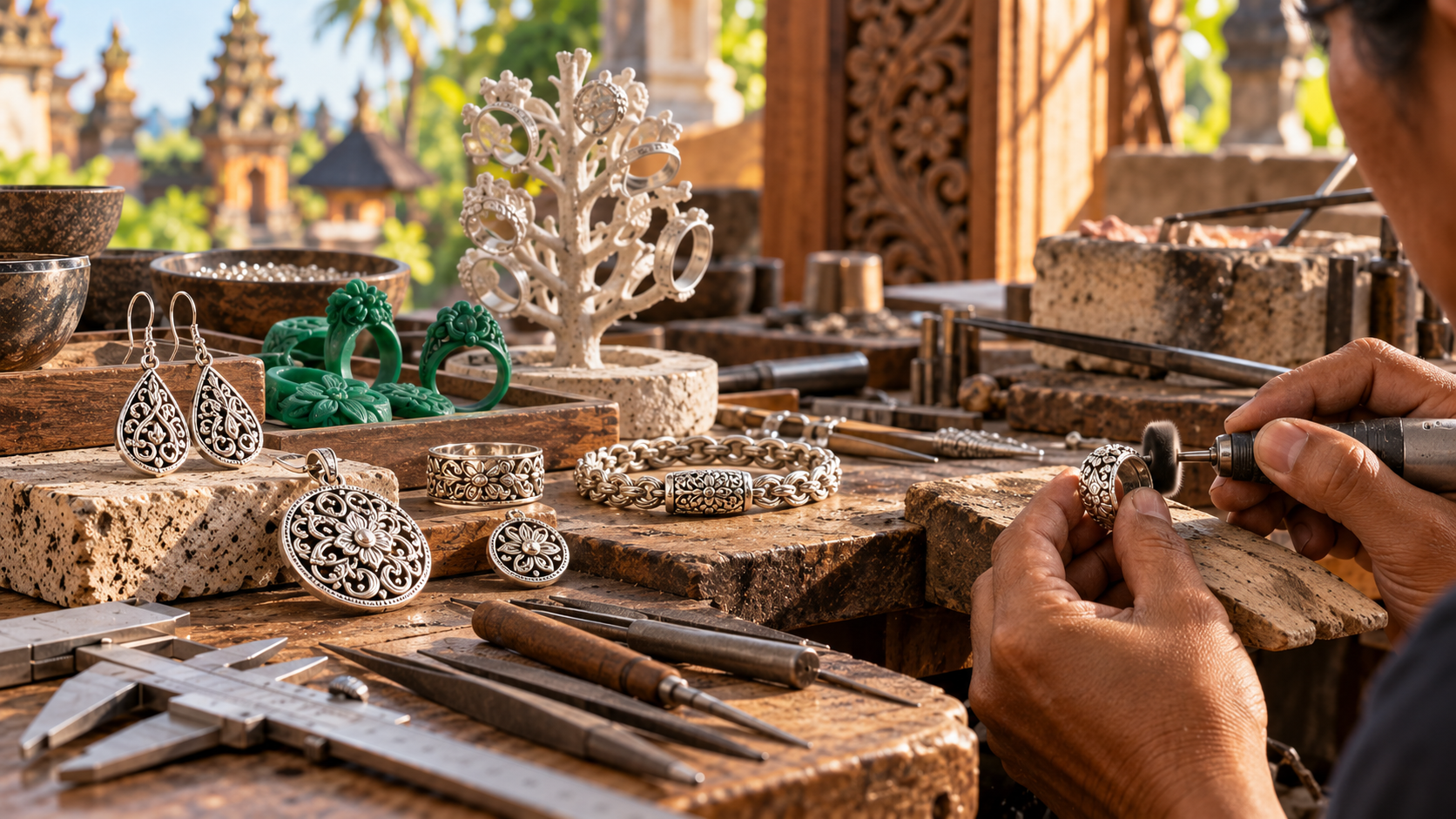
The jewelry industry has changed significantly over the past decade. Digital technology has improved design processes, global supply chains have expanded, and online marketplaces have made jewelry more accessible.
Manufacturers can now develop complex designs with CAD software, produce models through 3D printing, and manage orders with digital systems.
These improvements offer real benefits. They can reduce errors, support consistent quality, and help businesses serve customers more efficiently.
However, the industry’s growing focus on speed and low prices creates another challenge.
When jewelry businesses prioritize efficiency without protecting skilled workers, they risk losing the craftsmanship that gives their products lasting value.
This concern matters particularly to small and medium-sized manufacturers. It also matters in traditional jewelry-making communities, including Bali, Indonesia.
The jewelry industry is not necessarily declining in overall market size. However, some of the skills, working conditions, and business relationships that support traditional manufacturing may face increasing pressure.
This article explores the hidden costs of efficiency and considers how jewelry businesses can build a more sustainable future.
1. Why the Jewelry Industry Faces Increasing Pressure
Jewelry manufacturers operate in a highly competitive environment.
International brands can compare suppliers across different countries. Online marketplaces allow customers to compare prices within seconds. Meanwhile, manufacturers must manage changing material costs, labor expenses, and delivery expectations.
These conditions create strong incentives to improve productivity.
Efficiency itself is not the problem.
A workshop that reduces unnecessary waste or improves production planning can strengthen its business.
Problems arise when customers and manufacturers treat the lowest price as the main measure of success.
The Pressure to Produce More for Less
A jewelry manufacturer must consider several expenses before preparing a quotation:
- Precious metals and gemstones.
- Product development and sample making.
- Casting and fabrication labor.
- Stone setting and finishing.
- Quality control.
- Equipment and workshop maintenance.
- Administration and shipping preparation.
When buyers request lower prices, manufacturers cannot always reduce these expenses without consequences.
Some businesses improve their processes. Others may reduce quality, accept smaller margins, or place greater pressure on workers.
Over time, these decisions can weaken a workshop’s financial stability.
2. The Hidden Cost of Low-Cost Jewelry Production
Low-cost production can benefit customers and create opportunities for growing brands.
However, manufacturers must understand the difference between competitive pricing and unsustainable pricing.
A workshop may accept an order simply to keep its production team busy.
If the selling price barely covers expenses, the order may contribute little to future investment.
The business still needs funds for equipment, training, repairs, and employee development.
Why Profit Margins Matter
Profit does not only reward the business owner.
A reasonable operating margin helps a manufacturer maintain production capacity and respond to unexpected problems.
For example, a workshop may need to replace casting equipment or invest in improved ventilation.
It may also need to train a new worker before that employee becomes fully productive.
Without sufficient financial resources, these improvements become difficult.
The Long-Term Risk
A business that consistently accepts unprofitable work may struggle to maintain quality and retain experienced employees.
The consequences may appear gradually rather than immediately.
Production continues, but the workshop loses its ability to develop.
This is one way that an industry can experience a decline in capability even while businesses remain active.
3. Skilled Jewelry Artisans Are Difficult to Replace
Jewelry manufacturing requires more than equipment.
Experienced silversmiths understand metal behavior, construction methods, proportions, and finishing techniques.
They recognize problems that may not appear in a technical drawing.
A skilled worker can often identify a weak connection, an unsuitable stone setting, or a design that requires modification.
These abilities develop through training and practical experience.
Different Skills Support Jewelry Production
A typical jewelry workshop may rely on several specialized roles.
Wax model makers create models and prepare suitable shapes for casting.
Casting technicians manage metal preparation, casting conditions, and initial inspection.
Silversmiths fabricate components, solder joints, and assemble jewelry.
Stone setters secure gemstones while protecting the stones and surrounding metal.
Polishers and finishers refine surfaces and create the required appearance.
Quality control staff inspect dimensions, construction, finishing, and functional details.
Each role contributes to the finished product.
When experienced workers leave, a manufacturer may lose valuable knowledge that takes years to rebuild.
4. Why Younger Generations May Avoid Traditional Jewelry Careers
Traditional jewelry-making communities need new workers to maintain their skills.
However, young people have many career options today.
Tourism, hospitality, retail, technology, and other sectors may offer different working conditions and career opportunities.
Jewelry workshops must compete for talent.
The Training Challenge
A new employee rarely becomes a skilled silversmith immediately.
Workers need time to understand tools, materials, production methods, and quality requirements.
Some techniques require extensive practice.
During this period, the workshop must invest time and supervision.
If the business cannot offer reasonable income prospects or opportunities for advancement, younger workers may choose another career.
The Risk of Losing Traditional Skills
When experienced artisans retire without training successors, certain techniques may become less common.
This does not mean that every traditional skill will disappear.
However, maintaining these skills requires deliberate effort.
Workshops need to make jewelry manufacturing an attractive and realistic career, not simply expect younger generations to preserve tradition without suitable economic opportunities.
5. Bali’s Silver Jewelry Industry Faces a Unique Challenge
Bali has a long-established tradition of silver and gold craftsmanship.
Celuk Village and surrounding areas in Gianyar have developed strong connections with jewelry production.
Many local workshops combine traditional hand fabrication with casting and modern manufacturing methods.
This combination gives Bali a distinctive position in the international jewelry industry.
However, traditional craftsmanship depends on people.
The Changing Role of Bali Silversmiths
In earlier generations, artisans often learned jewelry-making skills through family businesses or local workshops.
Today, some young people pursue different careers.
Meanwhile, international customers expect reliable quality, competitive prices, and consistent delivery schedules.
Local manufacturers must balance these demands.
They need to maintain traditional skills while improving productivity and adapting to modern business requirements.
Preserving Skills Through Real Business Opportunities
Cultural appreciation alone cannot support a working jewelry industry.
Artisans need customers who value their work.
Workshops need profitable orders and realistic production schedules.
Younger employees need opportunities to learn and earn a living.
Preserving Balinese jewelry craftsmanship therefore requires both cultural interest and practical business development.
6. Does Technology Threaten Traditional Jewelry Making?
Technology often receives criticism when people discuss the future of handmade industries.
However, modern tools can support traditional craftsmanship.
CAD software allows designers to develop precise models.
3D printing can help workshops prepare complex patterns.
Laser engraving can create detailed markings.
Digital production records can improve order management.
These technologies can reduce repetitive work and support accuracy.
Technology Cannot Replace Every Skill
A CAD model does not automatically become a successful piece of jewelry.
Manufacturers still need to consider metal thickness, casting behavior, assembly, and finishing.
A complex design may look attractive on a screen but create problems during production.
Experienced workers can identify these issues and recommend practical changes.
The Better Approach: Technology and Craftsmanship Together
Jewelry businesses should use technology where it adds value.
For example, a workshop may use CAD to develop a precise master model while relying on skilled workers for assembly, stone setting, and finishing.
This approach can improve consistency without abandoning human expertise.
The goal should not be to eliminate workers.
Instead, manufacturers should help workers become more productive and capable through appropriate tools and training.
7. When Efficiency Begins to Reduce Jewelry Quality
Efficiency improves a business when it removes unnecessary work.
However, excessive cost-cutting can create new problems.
For example, a manufacturer may reduce inspection time to increase daily output.
This decision may initially save labor.
However, defects can lead to repairs, remakes, customer complaints, and delayed shipments.
The workshop may eventually spend more time correcting problems than it originally saved.
Common Quality Risks
Jewelry production requires careful control of several details.
Thin or poorly designed connections may weaken a product.
Inadequate soldering can affect structural strength.
Poorly finished surfaces can reduce customer satisfaction.
Incorrect gemstone settings can create durability problems.
Unreliable clasps may affect everyday use.
These issues demonstrate why manufacturers need realistic production standards.
Quality Is Part of Efficiency
A well-organized workshop should prevent defects rather than depend entirely on final inspection.
Workers can review designs before production, inspect components during assembly, and check finished products before shipping.
Better quality control can reduce unnecessary labor and material waste.
In this sense, good craftsmanship and efficiency support each other.
8. Why Competing Only on Price Is a Dangerous Strategy
Price remains an important purchasing factor.
However, jewelry buyers should compare more than the final quotation.
Two products may look similar in photographs but differ in construction, material specifications, weight, and finishing.
A lower price may reflect a more efficient process.
It may also reflect different specifications.
Understanding the Real Value of Manufacturing
Brands should consider:
- Material authenticity and composition.
- Product weight and dimensions.
- Manufacturing methods.
- Surface finishing quality.
- Gemstone specifications.
- Quality control procedures.
- Production consistency.
- Communication and delivery reliability.
These factors influence the overall value of a manufacturing partnership.
A Better Conversation Between Buyers and Manufacturers
Rather than requesting a lower price without changing specifications, buyers can discuss practical alternatives.
For example, a manufacturer may suggest a different construction method or adjust a nonessential design detail.
The customer may also increase order quantities to improve production efficiency.
Both parties can then evaluate the effects on cost and quality.
This approach encourages cooperation rather than constant price pressure.
9. The Challenge of Small-Batch Jewelry Manufacturing
Small jewelry brands often need limited production quantities.
They may want to test a new collection before placing a larger order.
Small-batch manufacturing creates opportunities for independent designers.
However, it also introduces production challenges.
Setup Costs Do Not Always Decrease with Quantity
A manufacturer may need to prepare a model, create a mold, organize casting, and develop finishing procedures.
These activities require time even when the customer orders only a few pieces.
As a result, small quantities can have higher unit costs.
How Brands Can Improve Small-Batch Production
Brands can start with fewer designs and simplify their initial collections.
They can also use standard components where suitable and confirm technical specifications before sample production.
Clear planning reduces unnecessary revisions.
For manufacturers, flexible order quantities can support long-term customer relationships when pricing covers the actual work.
A sustainable small-batch model must benefit both sides.
10. The Importance of Fair and Sustainable Employment
Jewelry manufacturing depends on skilled employees.
Workshops need compensation systems that reflect the type of work, local labor conditions, and business capacity.
Different production activities may require different arrangements.
For example, repetitive finishing work and highly specialized stone setting involve different skills and productivity measures.
Beyond Piecework Productivity
Piecework systems can reward output.
However, businesses should also consider quality, training, safety, and applicable employment requirements.
A system that rewards only quantity may encourage workers to rush.
Manufacturers can reduce this risk by combining clear quality standards with realistic production targets.
Investing in Employee Development
Workshops can strengthen their workforce through structured training.
Experienced artisans can guide new employees.
Supervisors can identify technical weaknesses and organize practical instruction.
Businesses can also create opportunities for workers to learn new techniques.
These investments take time, but they can improve long-term production capability.
11. Can Handmade Jewelry Survive Mass Production?
Mass production serves an important market.
Many customers want accessible jewelry at affordable prices.
Modern manufacturing can produce consistent products efficiently.
Handcrafted jewelry serves different needs.
Some customers appreciate distinctive details, traditional techniques, and the work of individual artisans.
These two approaches do not need to compete in every market.
Handmade Does Not Always Mean Better
A handmade product can have excellent quality, but the production method alone does not guarantee it.
Likewise, cast jewelry can achieve high standards when manufacturers control the process carefully.
Customers should evaluate the finished product rather than assume that one method always produces better results.
The Value of Craftsmanship
Traditional skills can add distinctive character to jewelry.
Hand engraving, filigree, granulation, and specialized fabrication techniques may create details that customers appreciate.
Brands can explain these techniques accurately and show the work behind their products.
Clear storytelling helps customers understand why certain pieces require more labor.
12. Sustainability Includes the People Behind Jewelry
Sustainability discussions often focus on recycled metals, packaging, and environmental impact.
These topics matter.
However, a responsible jewelry business should also consider its workforce and long-term production capabilities.
A workshop cannot maintain its craft without people who know how to make jewelry.
Environmental Responsibility
Manufacturers can reduce unnecessary material waste and recover suitable precious-metal scrap.
They can also improve production planning and maintain equipment properly.
These measures may support both environmental and financial goals.
Workforce Responsibility
Businesses should consider safe working conditions, suitable training, reasonable compensation practices, and opportunities for skill development.
They should also comply with applicable employment requirements.
Long-Term Business Responsibility
A manufacturer needs sufficient financial stability to maintain equipment, support employees, and fulfill customer commitments.
These three dimensions—environmental practices, workforce development, and financial sustainability—should support one another.
13. How Jewelry Brands Can Support Skilled Manufacturers
Jewelry brands influence manufacturing conditions through their purchasing decisions.
They can support reliable production relationships without abandoning commercial discipline.
Provide Clear Design Specifications
Accurate drawings, dimensions, material requirements, and reference images reduce misunderstandings.
They also help manufacturers prepare realistic quotations.
Allow Reasonable Production Time
Complex jewelry requires suitable development and manufacturing schedules.
Rushed production can increase errors and unnecessary costs.
Understand Sampling Costs
Sample development often requires additional work.
Brands should discuss model-making, tooling, and revision expenses before production begins.
Evaluate Quality Alongside Price
A manufacturing partner should offer suitable technical capabilities and consistent workmanship.
The lowest quotation may not provide the best long-term result.
Build Long-Term Relationships
Repeat orders and clear communication help manufacturers plan production and develop a better understanding of a brand’s requirements.
Stable relationships can benefit both customers and workshops.
14. What Jewelry Manufacturers Can Do Differently
Manufacturers also carry responsibility for improving the industry.
They cannot rely only on traditional skills or expect customers to accept inefficient processes.
Workshops must adapt.
Improve Production Planning
Clear schedules help teams coordinate casting, assembly, stone setting, and finishing.
Better planning can reduce unnecessary waiting and repeated work.
Measure the Right Performance Indicators
Businesses should monitor more than the number of pieces workers produce.
Useful indicators include defect rates, rework, delivery reliability, material loss, and actual production costs.
These measurements help managers identify opportunities for improvement.
Invest in Practical Technology
Manufacturers should choose tools that solve real production problems.
An expensive machine does not automatically improve profitability.
The benefits depend on order volume, technical requirements, and the workshop’s ability to use the equipment.
Develop Employee Skills
Training helps businesses maintain quality and prepare for future workforce changes.
Protect Reasonable Margins
Manufacturers should understand their costs and avoid accepting work that consistently undermines business stability.
Sustainable pricing supports long-term customer service.
15. Our Perspective at Puri Lautan Mutiara, Bali
At Puri Lautan Mutiara (PLM), we have worked in jewelry manufacturing in Bali since 1998.
Our workshop operates in Singapadu, Gianyar, near the traditional jewelry-making area of Celuk.
We work with international designers, jewelry brands, retailers, and wholesalers.
Our manufacturing capabilities include sterling silver, brass, selected gold jewelry, wax modeling, lost-wax casting, hand fabrication, gemstone setting, and finishing.
We also use CAD and 3D printing when appropriate.
As a small jewelry manufacturing business, we understand the importance of productivity.
We must control material costs, manage production schedules, and maintain competitive pricing.
However, we also recognize the importance of experienced workers.
Machines and software can support production, but people still make important decisions throughout the manufacturing process.
A skilled artisan can solve problems that a digital model cannot anticipate.
A careful quality control worker can prevent an unsuitable product from reaching a customer.
An experienced production team can help a designer transform an idea into a practical piece of jewelry.
For us, the challenge is not choosing between traditional craftsmanship and modern efficiency.
The challenge is finding a balance that allows both to develop together.
We believe small manufacturers can remain relevant by improving their processes, maintaining quality, and building reliable relationships with customers.
Learn more about our Custom Jewelry Manufacturing Services.
16. The Future of Jewelry Manufacturing: Better, Not Simply Cheaper
The jewelry industry will continue to change.
Technology will create new opportunities for design and manufacturing.
Customers will continue to compare prices and demand reliable service.
Manufacturers will need to improve their efficiency.
However, businesses should consider what they want efficiency to achieve.
Reducing waste and improving accuracy can strengthen a workshop.
Eliminating unnecessary work can free employees to focus on more valuable activities.
Training workers can improve productivity and quality at the same time.
These changes create benefits without treating craftsmanship as an unnecessary expense.
A More Balanced Industry
A healthier jewelry manufacturing sector needs several things:
- Businesses that understand their real costs.
- Brands that appreciate quality and reliability.
- Workers who can develop valuable skills.
- Technology that supports practical manufacturing.
- Customers who receive accurate product information.
- Long-term relationships throughout the supply chain.
No single workshop can solve every industry challenge.
However, each business can make decisions that support better manufacturing practices.
Frequently Asked Questions
Is the jewelry industry really declining?
Not necessarily. The global jewelry industry includes many different markets and business models. Some segments may grow while traditional workshops face pressure on margins, labor, or skills. A decline in craftsmanship should not be confused with a decline in total industry sales.
Why are traditional jewelry-making skills at risk?
Some skills require extensive training. If younger workers find better opportunities elsewhere, workshops may struggle to replace experienced artisans.
Does CAD technology replace silversmiths?
CAD can support design and model development, but manufacturers still need technical knowledge, assembly skills, finishing expertise, and quality control.
Why can handmade jewelry cost more?
Handmade details may require specialized labor and additional production time. However, the final cost also depends on materials, complexity, quantities, and manufacturing methods.
How can small jewelry workshops compete internationally?
They can focus on clear technical capabilities, consistent quality, realistic pricing, efficient processes, and strong customer relationships.
Is mass-produced jewelry lower quality than handmade jewelry?
Not automatically. Both approaches can produce good or poor results. Quality depends on suitable design, materials, manufacturing control, and finishing.
What can jewelry brands do to support responsible manufacturing?
Brands can provide clear specifications, allow realistic lead times, evaluate quality alongside price, and build stable relationships with suitable suppliers.
Conclusion: The Jewelry Industry Must Protect Its Greatest Asset
The jewelry industry has gained many advantages from modern technology and efficient production methods.
These improvements have helped businesses expand their capabilities and reach international customers.
However, the pursuit of lower prices and faster production can create hidden costs.
When workshops struggle to maintain reasonable margins, they may reduce investment in equipment, training, and employee development.
When experienced artisans leave without passing on their skills, the industry risks losing valuable knowledge.
The solution is not to reject technology or return to outdated manufacturing practices.
Instead, jewelry businesses should combine efficient systems with skilled craftsmanship and sustainable operations.
For Bali’s jewelry industry, this balance matters particularly because traditional metalworking skills form part of its cultural and commercial identity.
The future of jewelry manufacturing should not depend on producing everything at the lowest possible price. It should depend on creating lasting value for customers, manufacturers, and the people behind the craft.
At Puri Lautan Mutiara, we continue to explore this balance as we develop jewelry for international customers.
Contact Puri Lautan Mutiara to discuss custom jewelry development and manufacturing.
Puri Lautan Mutiara — Custom Jewelry Manufacturing in Bali Since 1998.