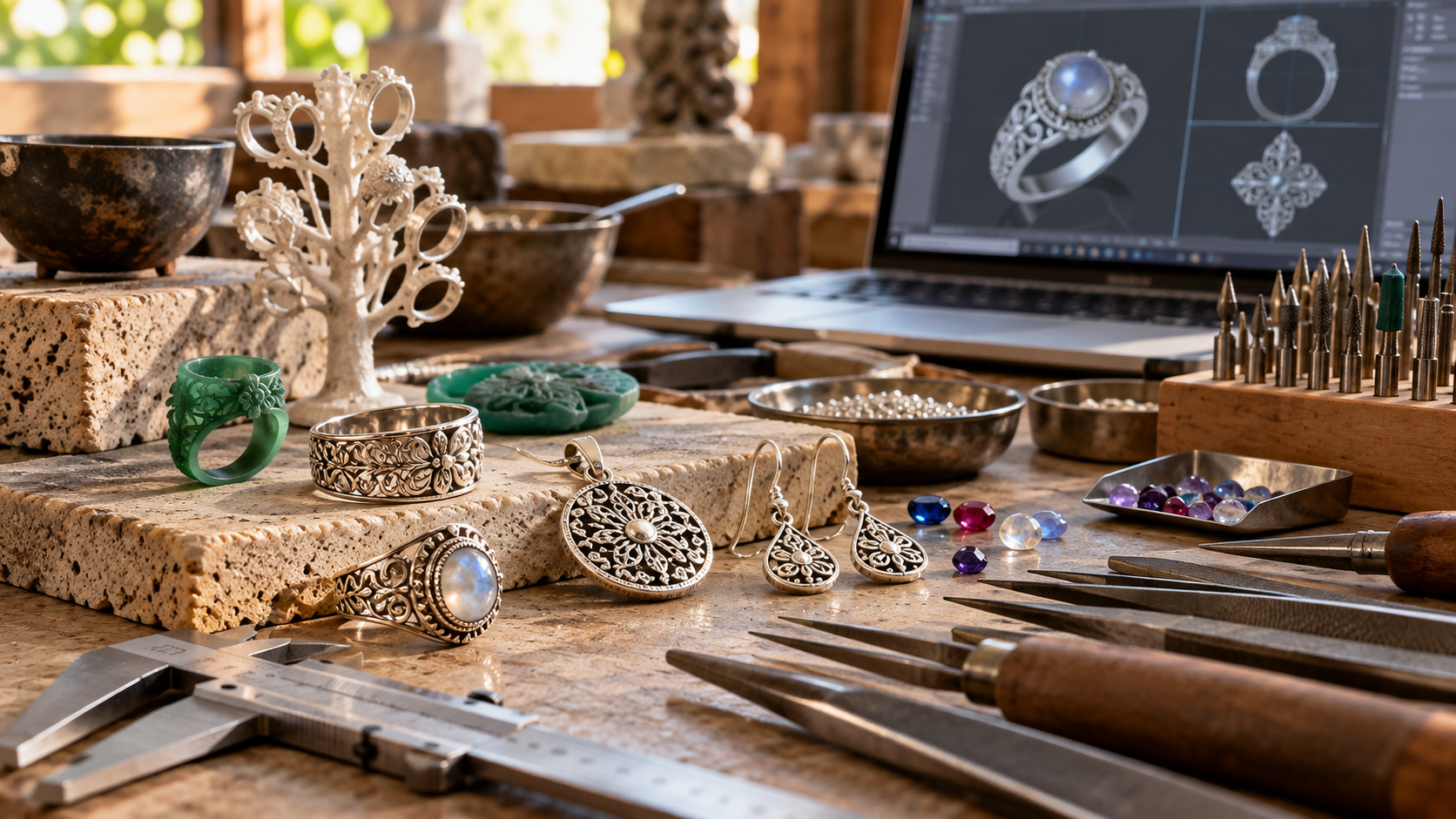
Understanding jewelry terminology helps designers, retailers, and customers make better decisions about materials, craftsmanship, and production.
The jewelry industry combines traditional metalsmithing techniques with modern technologies such as computer-aided design (CAD), 3D printing, and precision casting. Each production stage involves specific terms that may be unfamiliar to new buyers.
Whether you are developing a jewelry collection, ordering custom sterling silver jewelry, or simply exploring how jewelry is made, this glossary explains the essential terms used throughout the industry.
At PT Puri Lautan Mutiara (PLM Bali), we have worked with jewelry manufacturing since 1998. This guide combines traditional jewelry knowledge with practical terminology used in modern production.
A — Jewelry Terms
Abrasives
Abrasives are materials used to grind, shape, smooth, or polish metal surfaces. Jewelers commonly use sandpaper, grinding wheels, polishing compounds, and abrasive rubber wheels during finishing.
Alloy
An alloy combines two or more elements, including at least one metal, to improve properties such as strength, hardness, color, or workability.
Sterling silver, for example, contains 92.5% silver and 7.5% other metals, usually copper.
Annealing
Annealing involves heating metal to an appropriate temperature and cooling it under controlled conditions to reduce hardness and restore workability.
Jewelers frequently anneal silver and gold during forming, rolling, and wire production.
Anodizing
Anodizing is an electrochemical process that modifies the oxide layer on certain metals. It can create decorative colors on metals such as titanium and niobium.
The process differs from conventional gold or rhodium plating.
B — Jewelry Terms
Bail
A bail connects a pendant to a chain or cord. It may form part of the pendant design or attach as a separate component.
Base Metal
A base metal is a non-precious metal used in jewelry production. Common examples include brass, copper, and zinc-based alloys.
Bezel Setting
A bezel setting uses a metal rim to hold a gemstone securely. Jewelers shape the surrounding metal over the stone’s edge.
This technique is popular for cabochons, rings, pendants, and everyday jewelry.
Brass
Brass is an alloy primarily made from copper and zinc. Its yellow appearance makes it popular for fashion jewelry and gold-plated accessories.
Burnishing
Burnishing smooths and compresses a metal surface using a hard, polished tool. It can improve shine without removing as much material as abrasive polishing.
C — Jewelry Terms
CAD (Computer-Aided Design)
CAD software allows jewelry designers to create precise digital models.
Programs such as Rhino and specialized jewelry CAD applications help designers calculate dimensions, adjust stone settings, and prepare models for manufacturing.
CAM (Computer-Aided Manufacturing)
CAM uses computer-controlled equipment to produce physical components from digital designs.
Jewelry workshops may use CNC milling and other computer-controlled processes alongside CAD.
Casting
Casting creates metal jewelry by pouring or forcing molten metal into a prepared mold cavity.
Lost-wax casting is one of the most widely used methods for producing detailed jewelry.
Casting Tree
A casting tree consists of several wax jewelry patterns connected to a central sprue.
This arrangement allows a workshop to cast multiple pieces during one production cycle.
Claw Setting (Prong Setting)
A claw setting holds a gemstone with small metal prongs. It allows more of the stone to remain visible than many enclosed settings.
Cold Connection
A cold connection joins jewelry components without soldering or welding.
Examples include rivets, screws, and certain mechanical fasteners.
D — Jewelry Terms
Die Striking
Die striking forms metal by pressing it between shaped dies under substantial pressure.
Manufacturers use this technique for components that require consistent shapes and dimensions.
Design Tolerance
Design tolerance describes the acceptable variation from a specified measurement.
Jewelry manufacturers use tolerances to control ring dimensions, stone settings, component thickness, and assembly.
E — Jewelry Terms
Electroplating
Electroplating uses an electrical current to deposit a thin metal coating onto a prepared surface.
Gold plating and rhodium plating are common examples in jewelry manufacturing.
Enameling
Traditional vitreous enameling involves fusing powdered glass onto metal using heat.
Some modern decorative products use resin-based coatings, which differ from traditional glass enamel.
Engraving
Engraving creates decorative patterns, letters, or images by removing material from a surface.
Jewelers may engrave designs manually, mechanically, or with laser equipment.
Etching
Etching removes selected areas of metal through chemical or electrochemical processes to create textures or patterns.
F — Jewelry Terms
Findings
Findings are components used to assemble jewelry.
Examples include clasps, jump rings, ear posts, earring backs, bails, and connectors.
Firescale
Firescale refers to oxidation-related discoloration that can develop in certain silver and gold alloys during heating.
Proper temperature control, protective flux, and finishing techniques help reduce its effects.
Flux
Flux helps protect metal surfaces from oxidation during soldering and promotes proper solder flow.
G — Jewelry Terms
Gemstone Setting
Gemstone setting is the process of securing stones within jewelry.
Common methods include bezel, prong, pavé, channel, and flush settings.
Gold-Filled
Gold-filled jewelry contains a mechanically bonded layer of gold over a base-metal core.
It differs from conventional gold electroplating and must meet applicable composition and labeling requirements.
Gold Plating
Gold plating applies a thin layer of gold to another metal.
The appearance and durability depend on the coating thickness, underlying metal, surface preparation, and usage conditions.
Gold Vermeil
Gold vermeil is a specific type of gold-plated sterling silver jewelry.
Under U.S. FTC guidance, vermeil requires a sterling silver base and a gold coating of at least 10 karats and 2.5 microns in thickness.
Different markets may apply different labeling requirements.
Granulation
Granulation decorates jewelry with tiny metal spheres arranged into patterns.
This traditional technique creates detailed surface textures and is particularly suitable for ornamental jewelry.
H — Jewelry Terms
Hallmark
A hallmark is a mark that provides information about precious metal content, origin, or official testing, depending on the marking system.
Not every jewelry stamp is an independently verified hallmark.
Hand Fabrication
Hand fabrication involves constructing jewelry from metal sheets, wires, and other components using traditional workshop techniques.
High Polish
High polish describes a reflective, mirror-like metal finish achieved through careful sanding and polishing.
I — Jewelry Terms
Investment Casting
Investment casting uses a refractory mold material surrounding a wax or other expendable pattern.
After the pattern is removed, molten metal fills the resulting cavity.
Inlay
Inlay involves placing materials such as gemstones, shell, wood, or enamel into prepared recesses in a jewelry surface.
J — Jewelry Terms
Jewelry Findings
Jewelry findings include the functional components used to complete and connect jewelry pieces, such as earwires, clasps, posts, and jump rings.
Jump Ring
A jump ring is a small metal ring used to connect jewelry components.
It may be open for assembly or soldered closed for additional security.
K — Jewelry Terms
Karat (K)
Karat measures the proportion of pure gold in a gold alloy.
- 24K: Approximately pure gold
- 22K: Approximately 91.7% gold
- 18K: 75% gold
- 14K: Approximately 58.3% gold
- 9K: 37.5% gold
Gold purity requirements and labeling regulations vary between markets.
L — Jewelry Terms
Laser Engraving
Laser engraving uses focused laser energy to create marks, text, and patterns on jewelry surfaces.
Lost-Wax Casting
Lost-wax casting produces metal objects from expendable wax patterns.
The process typically includes pattern preparation, sprue assembly, investment, burnout, casting, cleaning, and finishing.
It is widely used for sterling silver and gold jewelry production.
M — Jewelry Terms
Mandrel
A mandrel is a tool used to shape or measure metal components.
Ring mandrels help jewelers form round ring bands and check their dimensions.
Metal Clay
Metal clay combines fine metal particles with organic binders and water.
After shaping and firing, the binders burn away and the metal particles sinter into a solid structure.
Micron
A micron, also called a micrometer (µm), equals one-thousandth of a millimeter.
Jewelry manufacturers use microns to describe plating thickness.
For example, 2.5 microns equals 0.0025 millimeters.
Minimum Order Quantity (MOQ)
MOQ refers to the minimum number of pieces a supplier accepts for an order.
The quantity may depend on design complexity, material requirements, and production methods.
Mold Making
Mold making creates a reusable mold from a master jewelry model.
Manufacturers commonly use rubber or silicone molds to reproduce wax patterns for casting.
N — Jewelry Terms
Nickel-Free Jewelry
Nickel-free jewelry is described as containing no intentionally added nickel, but claims should be supported by appropriate material controls or testing.
Some markets regulate nickel release rather than simply the total nickel content.
O — Jewelry Terms
OEM (Original Equipment Manufacturer)
In jewelry manufacturing, OEM commonly describes production based on a customer’s design or specifications.
ODM (Original Design Manufacturer)
ODM generally describes products designed or developed by a manufacturer and offered to customers, potentially with agreed modifications or branding.
Oxidized Finish
An oxidized finish creates darkened areas on metal surfaces.
Jewelers often use controlled chemical treatments to emphasize recessed patterns and decorative details in sterling silver.
P — Jewelry Terms
Patina
Patina describes a surface coloration or chemical alteration that develops naturally or through intentional treatment.
Pavé Setting
Pavé setting places numerous small gemstones close together, creating a surface that appears covered with stones.
Pickling
Pickling uses an appropriate chemical solution to remove oxidation and flux residue after heating or soldering.
Piercing
In metalsmithing, piercing means cutting openings or decorative shapes through metal sheet, commonly using a jeweler’s saw.
It should not be confused with body piercing.
Polishing
Polishing removes fine surface imperfections and produces a smoother, brighter finish.
Prototype
A prototype is an initial physical or digital model used to evaluate a jewelry design before production.
Q — Jewelry Terms
Quality Control (QC)
Quality control involves inspecting jewelry against established specifications.
Common checks include dimensions, weight, solder joints, gemstone security, surface finishing, and plating quality.
R — Jewelry Terms
Repoussé
Repoussé is a traditional metalworking technique that creates raised decorative forms by working metal from the reverse side.
Rhodium Plating
Rhodium plating applies a thin rhodium coating to jewelry.
It provides a bright, reflective finish and is commonly used on white gold and sterling silver.
Ring Size
Ring size describes the dimensions required for a ring to fit a finger.
Sizing systems differ between countries, including U.S., UK, European, and Japanese standards.
S — Jewelry Terms
Sand Casting
Sand casting uses a prepared sand mold to create metal objects.
It differs from investment casting in mold preparation and the types of detail it can reproduce.
Soldering
Soldering joins metal components using a filler alloy that melts at a lower temperature than the parts being joined.
Sprue
A sprue forms part of the channel system that allows molten metal to enter a casting mold.
In wax assembly, sprues also connect patterns to the casting tree.
Sterling Silver 925
Sterling silver contains 92.5% silver by mass, with the remaining 7.5% consisting of other metals.
Copper is the most common alloying element.
Sterling silver offers a practical balance of precious metal content, workability, and strength.
STL File
An STL file describes the surface geometry of a three-dimensional object using a triangular mesh.
Jewelry designers commonly use STL files for 3D printing and related manufacturing processes.
T — Jewelry Terms
Tarnish
Tarnish is surface discoloration caused by chemical reactions with the environment.
Sterling silver commonly tarnishes through reactions involving sulfur-containing compounds.
Proper storage and cleaning can help reduce tarnishing.
Texture
Texture describes the visual or physical character of a jewelry surface.
Examples include hammered, brushed, satin, matte, and engraved finishes.
Tumbling
Tumbling places jewelry components in a rotating or vibrating container with suitable media.
The process can deburr, smooth, clean, or burnish surfaces depending on the equipment and media.
U — Jewelry Terms
Ultrasonic Cleaning
Ultrasonic cleaning uses high-frequency vibrations in a liquid bath to loosen contaminants from jewelry.
Some gemstones, treated stones, and delicate assemblies may not be suitable for ultrasonic cleaning.
Under Gallery
An under gallery is the supporting structure beneath the main decorative or gemstone-setting area of a jewelry piece.
V — Jewelry Terms
Vacuum Casting
Vacuum-assisted casting uses reduced pressure to help molten metal fill a mold and improve casting performance.
Vermeil
Vermeil refers to qualifying gold-plated sterling silver jewelry. Its precise legal definition depends on the destination market.
W — Jewelry Terms
Wax Carving
Wax carving involves shaping jewelry models by hand before casting.
It remains an important technique for developing sculptural and organic designs.
Wax Injection
Wax injection introduces molten wax into a prepared mold to reproduce jewelry patterns.
White Brass
White brass refers to certain pale-colored copper-based alloys, although the term does not identify one standardized composition.
Buyers should confirm the actual alloy specification and applicable metal-safety requirements.
X — Jewelry Terms
XRF (X-Ray Fluorescence)
XRF is a non-destructive analytical technique used to identify and estimate the elemental composition of materials.
Jewelry manufacturers and testing laboratories use XRF to assess precious metal alloys and, with suitable equipment and calibration, certain plating systems.
Standard bulk-metal XRF measurements do not automatically provide accurate plating thickness results.
Y — Jewelry Terms
Yellow Gold
Yellow gold is a gold alloy whose characteristic color comes from its gold content and the proportions of other metals, commonly silver and copper.
Z — Jewelry Terms
Zinc
Zinc is a metal commonly used in brass alloys.
Its proportion influences properties such as color, hardness, and workability.
Understanding Jewelry Manufacturing: From Design to Finished Product
Jewelry manufacturing combines many of the techniques described in this glossary.
A typical custom jewelry project follows several stages:
- Design development: The customer provides sketches, reference images, or technical specifications.
- CAD modeling or wax carving: The manufacturer prepares a production-ready model.
- Prototyping and mold making: The workshop evaluates the design and prepares reusable molds when appropriate.
- Casting or fabrication: Jewelers produce the metal components.
- Assembly and gemstone setting: Craftspeople complete the required construction and stone setting.
- Polishing and plating: The workshop applies the specified surface finish.
- Quality control: Inspectors check the finished jewelry against the agreed specifications.
Not every design follows exactly the same process. Handmade pieces, cast jewelry, and mixed-technique products may require different production methods.
Jewelry Manufacturing in Bali, Indonesia
Bali has a longstanding tradition of silversmithing, particularly in communities such as Celuk, Gianyar.
Today, Balinese jewelry workshops combine traditional craftsmanship with modern design and manufacturing technology.
At PT Puri Lautan Mutiara (PLM Bali), we have manufactured jewelry since 1998.
Our small workshop produces custom jewelry in sterling silver, brass, and gold, combining traditional techniques with CAD modeling, lost-wax casting, mold making, gemstone setting, and finishing.
We work with jewelry designers, retailers, and brands that need custom manufacturing or small production batches.
Our typical minimum order quantity starts at approximately 5–10 pieces per style or size, depending on the design.
We believe that understanding jewelry terminology helps customers communicate more effectively with manufacturers, avoid misunderstandings, and make informed production decisions.
Frequently Asked Questions About Jewelry Manufacturing
What does 925 mean on silver jewelry?
The number 925 indicates a claimed silver fineness of 925 parts per thousand, equivalent to 92.5% silver. A stamp alone does not independently verify metal purity.
What is the difference between casting and handmade jewelry?
Casting forms metal in a mold, while hand fabrication constructs jewelry through techniques such as cutting, forming, soldering, and assembly. Many jewelry pieces combine both methods.
What is the difference between gold plating and gold vermeil?
Gold plating is a general process of applying a gold coating. Vermeil is a specific category of gold-plated sterling silver that must satisfy applicable material and coating requirements.
Why do jewelry manufacturers use CAD?
CAD helps designers control dimensions, review proportions, prepare technical models, and develop complex jewelry designs before production.
What does MOQ mean when ordering custom jewelry?
MOQ stands for Minimum Order Quantity. It indicates the smallest order a manufacturer is willing to produce under specified conditions.
Final Thoughts
Jewelry terminology covers everything from traditional metalsmithing to advanced digital manufacturing.
Understanding these terms helps buyers compare materials, communicate with designers, and evaluate jewelry quality more confidently.
For jewelry brands, clear technical specifications also help manufacturers produce consistent results.
If you are developing a new jewelry collection or looking for a manufacturing partner in Bali, we welcome your inquiries.
Contact PLM Bali for Custom Jewelry Manufacturing
PT Puri Lautan Mutiara — Bali Jewelry Manufacturer Since 1998.